Last updated: November 20, 2026.
This article contains affiliate links. If you buy through them, we may earn a commission at no extra cost to you.
An electric pickup or SUV can carry several times the energy of a typical home battery. With vehicle-to-home (V2H) charging, that energy can run your house during an outage, and rooftop solar can help refill it. The idea is simple, but the hardware, compatibility and wiring are not. This guide explains how V2H works with solar, which systems are actually available in the US today, what the codes say, and what has changed with federal incentives.
Quick answer
- What V2H does: sends power from a compatible EV’s battery into your home’s wiring, usually as backup during a grid outage.
- What you need: a bidirectional-capable EV, a compatible bidirectional charger, and equipment that safely isolates (“islands”) your home from the grid, such as a transfer switch or gateway, installed by a licensed electrician with permits.
- Available US systems (Nov 2026): Ford F-150 Lightning with Ford’s Intelligent Backup Power setup, the GM Energy V2H Bundle for several GM EVs, Tesla Cybertruck Powershare, and Kia EV9 with the Wallbox Quasar 2. Others (Enphase, Hyundai, Rivian) have been announced.
- With solar: Whether solar can recharge your EV during an outage depends on the system. Tesla confirms it when a Powerwall is part of the setup; don’t assume it for every configuration.
- Incentives: The federal 25D homeowner credit ended for expenditures after December 31, 2025, and the 30C charger credit ended for property placed in service after June 30, 2026 (IRS). Some utility programs, such as PG&E’s V2X pilot, still help.

V2H vs. V2L vs. V2G: what’s the difference?
The Department of Energy groups these under “vehicle-to-everything” (V2X), describing EVs as mobile power export devices that can back up homes, buildings or the grid (DOE).
| Term | What it powers | Connection to home wiring | Typical use |
|---|---|---|---|
| V2L (vehicle-to-load) | Devices plugged into the car’s outlets | None | Camping, tools, a fridge via extension cord |
| V2H (vehicle-to-home) | Your home’s circuits | Yes, through isolation equipment | Outage backup |
| V2G (vehicle-to-grid) | The utility grid | Yes, under a utility interconnection agreement | Grid services, utility programs |
Tesla’s explainer lists the core V2H components: a bidirectional EV, an inverter (in the car or in the charger), a bidirectional charger, and an islanding controller that disconnects the home from the grid (Tesla).
How V2H works with rooftop solar
- Normal days: Solar powers the home, exports surplus under your utility’s net metering or net billing rules, and can charge the EV, ideally midday when production peaks.
- Outage starts: The gateway or transfer switch disconnects the home from the grid. Tesla notes the home may lose power briefly when backup starts and ends.
- EV supplies the home: The bidirectional charger draws from the vehicle battery until it reaches the reserve you’ve set, or the grid returns.
- Solar during the outage: In a properly designed islanded system, solar can keep supplying the home and, in some setups, recharge the EV. Grid-tied inverters shut down in an outage unless the system is designed to form a microgrid, so this depends entirely on your equipment.
Important: Tesla confirms that with a Powerwall in the system, solar can power the home, charge the Powerwall or charge the Cybertruck during an outage. We found no confirmation from Ford, Sunrun or GM that solar recharges the vehicle during an outage in every configuration. Ask your installer to put this in writing before you buy.
V2H systems available in the US (November 2026)
| System | Compatible vehicles | Backup power | Status and notes |
|---|---|---|---|
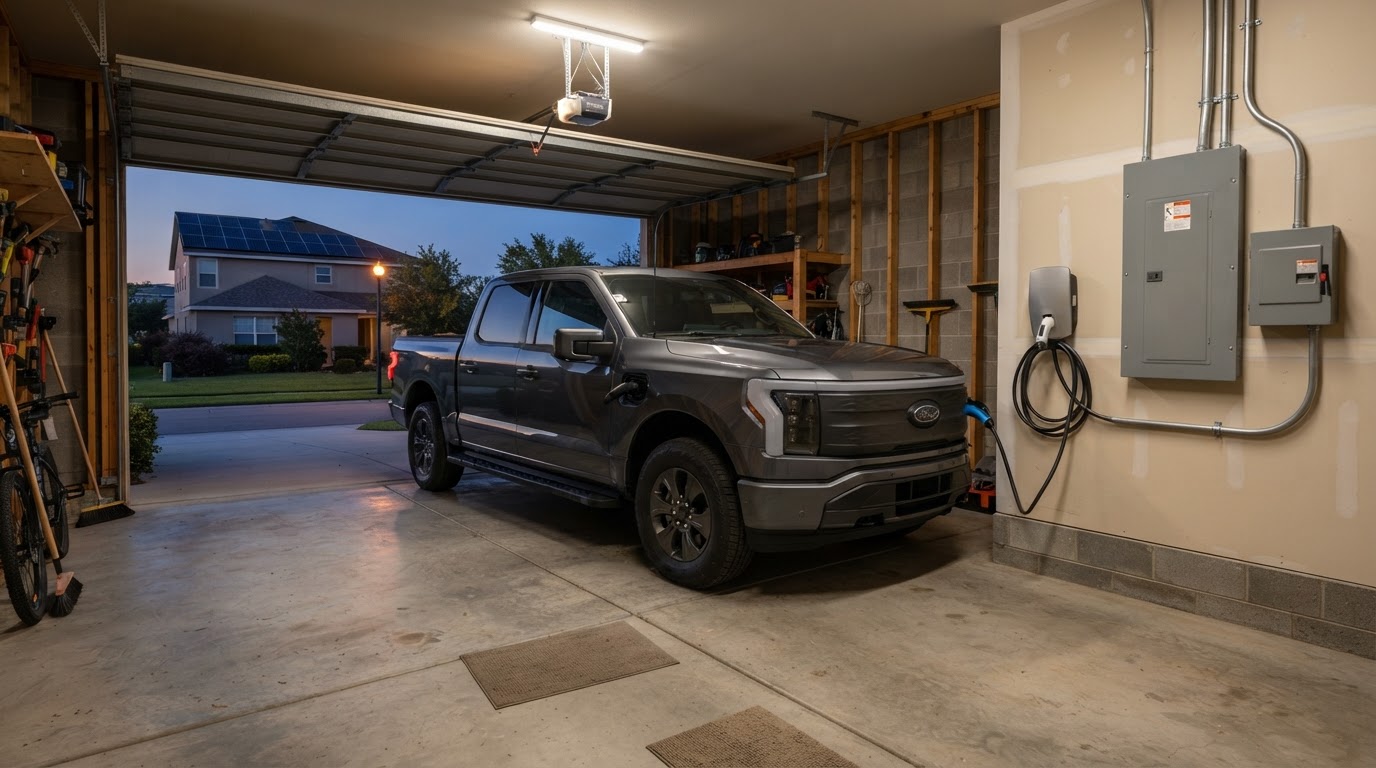
| Ford Intelligent Backup Power: Charge Station Pro (80A) + Home Integration System | F-150 Lightning | Up to 9.6 kW | Available through Sunrun; Ford announced in Dec 2025 it is ending production of the all-electric Lightning, so this mainly serves existing owners and used buyers |
| GM Energy V2H Bundle: PowerShift Charger + V2H Enablement Kit | Silverado EV, Sierra EV, Blazer EV, Equinox EV, Hummer EV, Lyriq, Optiq, Vistiq, Escalade IQ, Celestiq, 2027 Bolt | 9.6 kW | Home Hub supports whole- or partial-home backup on services up to 200A |
| Tesla Cybertruck Powershare | Cybertruck (all trims) | Up to 11.5 kW | Needs Powershare Gateway + Universal Wall Connector, or works with Powerwall 3 |
| Wallbox Quasar 2 (DC bidirectional) | Kia EV9 | 12 kW | Needs a Power Recovery Unit for outage backup |
| Enphase IQ Bidirectional EV Charger | 400 V and 800 V EVs (per Enphase) | 11.5 kW | Announced Sept 2025 with a second-half 2026 target; we could not confirm shipping |
Also announced but not yet available for US home backup: Hyundai’s AllDayEnergy platform (UK first, US later, no date) and Rivian’s R2 V2H, which depends on a future Rivian charger with no timeline. We found no official US V2H home-backup product from Lucid.
Product links
- GM Energy V2H Bundle: [AFFILIATE LINK]
- Tesla Powershare Home Backup: [AFFILIATE LINK]
- Wallbox Quasar 2: [AFFILIATE LINK]
How long can an EV power a house?
The average US home used about 10,791 kWh of electricity in 2022, roughly 29.6 kWh per day, though usage ranges widely by state (EIA). Manufacturers’ own estimates use about 30 kWh per day: Tesla says Cybertruck Powershare can back up a home for “over three days,” and Sunrun says an extended-range F-150 Lightning (131 kWh usable) equals “more than 10 home batteries.”
Estimate your own backup time
Backup days = (battery kWh × share you’re willing to use × conversion efficiency) ÷ daily home use
Illustrative example (our assumptions): an 80 kWh pack, using 70% of it so you can still drive, with about 90% efficiency, gives roughly 50 kWh. At 30 kWh per day that’s about 1.7 days; trimming usage to essentials (fridge, lights, internet, furnace fan) at 15 kWh per day stretches it to more than 3 days. Add midday solar recharging and the outage you can ride through grows further, if your system supports it.
Power vs. energy
Battery size (kWh) tells you how long you can run; the charger’s power rating (kW) tells you how much you can run at once. A 9.6 kW system may not start a large central air conditioner along with an electric range and dryer. Many installers back up a critical-loads panel rather than the whole home.
Codes and safety standards
- UL 9741 is the safety standard for EV power export equipment, and UL Solutions launched a certification program in September 2026 under the newer UL 1741 SC for AC bidirectional equipment, building on SAE J3072 interconnection requirements (ESS News).
- NEC (NFPA 70), 2023 edition: Article 625 covers EV charging and power export equipment, and new section 625.49 allows an EV to serve as an optional standby system in island mode. Article 702 covers optional standby systems, including sizing the system for the load or using an energy management system (EC&M). Article 705 covers interconnection with other power sources.
- Never backfeed: Do not connect an EV or inverter to home wiring through a dryer outlet or “suicide cord.” Without proper isolation, power can flow onto utility lines and endanger line workers.
V2H installation involves your service panel and often utility notification or an interconnection agreement. Use a licensed electrician and pull local permits.
Costs and incentives (as of November 2026)
Costs vary widely with the system, your panel and the installation. A few published data points:
- Tesla listed the Powershare Home Backup bundle at $1,970 in its US shop, installation not included, and marked it out of stock when we checked (Tesla shop).
- Wallbox launched the Quasar 2 for the Kia EV9 at $6,440 in March 2025, before installation (Automotive World); current bundles with backup hardware cost more.
- GM did not show a base price for its V2H bundle on its site.
Get itemized quotes for hardware, electrical work, panel upgrades and permits.
Federal credits
According to the IRS, the Residential Clean Energy Credit (25D) is not allowed for expenditures made after December 31, 2025, and the 30C refueling property credit is not allowed for property placed in service after June 30, 2026. Don’t count on either for a new V2H or solar purchase.
State and utility programs
- PG&E (California) V2X pilot: offers up to $4,500 upfront plus up to $4,300 for interconnection costs for eligible residential customers; enrollment closes June 30, 2027 (PG&E).
- Maryland: lawmakers passed the DRIVE Act in 2024 to streamline interconnection for bidirectional EVs (Utility Dive).
- Search for other programs by state on DSIRE and check with your utility.
Pros and cons of V2H with solar
| Pros | Cons |
|---|---|
| Large battery capacity compared with most home batteries | Limited vehicle and charger compatibility |
| Can stretch outage backup when paired with solar | Backup is gone when the vehicle is away from home |
| Uses an asset you already own | Installation costs and panel upgrades can be significant |
| Potential utility program payments | Federal credits no longer apply; solar recharge during outages isn’t guaranteed in every setup |
FAQ
Can my EV power my house during a power outage?
Only if both the vehicle and the charger support V2H and your home has proper isolation equipment. Check the automaker’s official compatibility list.
Can solar panels charge my EV during a blackout?
Sometimes. It depends on whether your solar and backup system can form an islanded microgrid. Tesla confirms this with a Powerwall in the system; confirm with your installer for other setups.
How long can an EV power a house?
Tesla estimates “over three days” for a Cybertruck at roughly 30 kWh per day. Your result depends on battery size, the reserve you keep for driving and how much you use.
Which EVs support vehicle-to-home in the US?
As of November 2026, the F-150 Lightning, a range of GM EVs with the GM Energy V2H Bundle, Tesla Cybertruck and Kia EV9 (with Wallbox Quasar 2). Other brands have announced plans.
Does V2H hurt my EV battery?
Any discharge adds cycles, but outage use is occasional. Check your vehicle’s battery warranty terms for bidirectional use before enrolling in frequent grid programs.
Is V2H the same as a home battery?
No. A home battery stays put and is always available. V2H uses a mobile battery that may be away when the power goes out, which is why some homeowners pair V2H with a smaller stationary battery.
Conclusion
Vehicle-to-home charging can turn a compatible EV into one of the largest backup batteries a household can own, and rooftop solar can make that backup last longer. The catch is compatibility: you need the right vehicle, charger, isolation equipment and, for solar recharging during outages, a system designed to island. Confirm compatibility with the automaker, get a licensed installer to spell out what works during an outage, and check utility programs now that federal credits have ended. To size the solar side, see our guide on how many solar panels it takes to charge an electric car, and compare ownership options in solar lease vs. buy.