This article contains affiliate links. If you buy through them, we may earn a commission at no extra cost to you.
If you have rooftop solar and an EV, the obvious question is how to fill the car with your own sunshine instead of exporting it to the grid for a small credit. Any Level 2 charger can run on solar power in the sense that your panels feed your home’s electrical system. A solar EV charger, though, actively follows your solar output and charges the car only with surplus power. This guide explains how that works, which chargers sold in the US support it, and when it is worth setting up.
Quick answer
A solar EV charger measures how much solar power your home is exporting and adjusts the car’s charging current to match, so you charge mostly on excess solar. In the US, chargers with this feature include:
- the Enphase IQ EV Charger 2;
- Emporia chargers paired with a Vue energy monitor;
- the Wallbox Pulsar Plus with its Power Meter;
- the SolarEdge Home EV Charger;
- the Tesla Wall Connector when paired with a Powerwall.
Because a Level 2 charger cannot charge below about 6 A (roughly 1.4 kW at 240 V), you need a steady surplus of at least that much for solar-only charging. You do not need a home battery for most of these systems; Tesla’s Charge on Solar is the main exception.
Table of Contents
How solar EV charging works
A standard Level 2 charger delivers a fixed current, for example 32 A or 48 A. If your panels produce 4 kW and the car draws 7.7 kW, the difference comes from the grid. A solar-aware charger instead:
- Measures power flow at your main service, using current transformer (CT) clamps, an energy monitor, or data from your solar inverter.
- Calculates the surplus: solar production minus what the house is using.
- Adjusts the charging current up or down in small steps, pausing when the surplus drops below the minimum.
The limit is set by the J1772 charging standard: the pilot signal can’t ask the car to draw less than 6 A. At 240 V that is about 1.44 kW (our calculation). On a cloudy day or with a small array, your surplus may hover below that, and the charger will either pause or top up from the grid, depending on your settings. Chargers that adjust in fine steps, such as the Enphase IQ EV Charger 2 (1 A increments), track a changing surplus more closely.
US homes have 120/240 V split-phase service, so the minimum charging power here is lower than in countries where chargers use three-phase power. That makes solar-only charging easier to achieve with modest rooftop arrays.
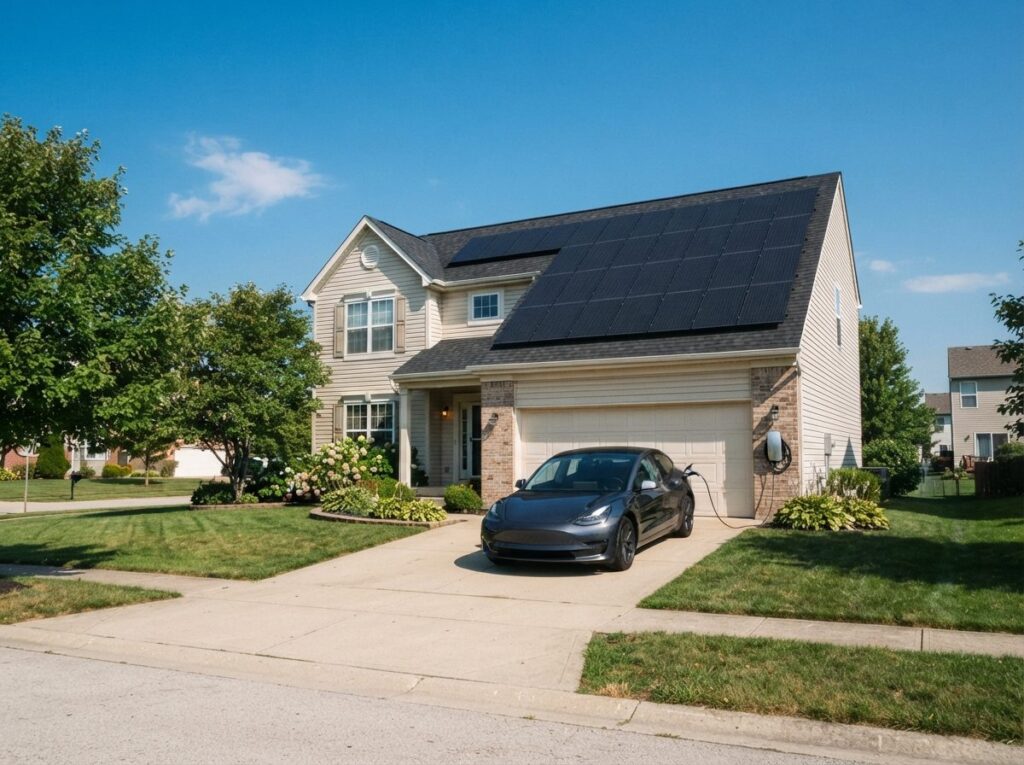
Solar EV chargers available in the US (2026)
Features below are from manufacturer pages checked in November 2026. We have not tested these chargers. Confirm compatibility with your solar system before buying.
| Charger | Max output | How solar mode works | Works with any solar brand? |
|---|---|---|---|
| Enphase IQ EV Charger 2 | Up to 19.2 kW (J1772) / 22.1 kW (NACS); up to a 60 A breaker | Checks available power every 30 seconds and adjusts in 1 A steps | Designed for Enphase systems; also works as a standalone charger |
| Emporia Classic / Pro | 6–48 A adjustable | Vue 2 or Vue 3 energy monitor with CTs on the mains; charging starts at minimum and ramps up with surplus | Yes, because it measures at the main service |
| Wallbox Pulsar Plus | 40 A or 48 A, up to 11.5 kW | Requires the Wallbox Power Meter (listed at $299 on Wallbox’s US site, Nov. 2026) | Yes, via the meter |
| SolarEdge Home EV Charger | 40 A, 9.6 kW | Excess-solar charging set in the mySolarEdge app; “Solar Boost” mode | Designed for SolarEdge inverters; also works standalone |
| Tesla Wall Connector + Powerwall | 48 A, 11.5 kW | Charge on Solar through the Tesla app; Tesla says it works for any EV make with Powerwall and a compatible Wall Connector | Requires a Tesla Powerwall |
Note on the Enphase figures: the high kW ratings apply at the charger’s maximum current; most homes install EV chargers on 40–60 A circuits, and real charging speed is also limited by the car’s onboard charger.
Tesla owners without a Powerwall: Tesla’s vehicle-based Charge on Solar feature also requires Powerwall with solar, needs at least 1.2 kW of stable surplus before it starts, and adjusts about every 10 seconds. Without a Powerwall, a brand-agnostic option such as an energy-monitor-based charger is the usual route.
Compare chargers: [AFFILIATE LINK – Emporia EV charger bundle] · [AFFILIATE LINK – Wallbox Pulsar Plus]
How much solar do you need to charge an EV?
Here is a simple worked example using federal data (our calculation):
- DOE’s Alternative Fuels Data Center uses an example EV efficiency of 27 kWh per 100 miles.
- DOE reports that a vehicle in a one-vehicle household travels about 50 miles per day on average (2022 National Household Travel Survey).
- That works out to about 13.5 kWh per day. NREL data put residential solar capacity factors at roughly 12.7–19.6% across US locations, or about 1,100–1,700 kWh per kW per year.
- At about 1,400 kWh/kW/year (around 3.8 kWh per kW per day), you would need roughly 3.5 kW of solar just for that driving, on top of what your house uses.
For a detailed panel count, see our guide on how many solar panels it takes to charge an electric car, and run your own address through NREL PVWatts.
The timing problem: solar-only charging only works when the car is plugged in during daylight. If your EV is at work all day, surplus charging may help mainly on weekends. In that case a battery, a workplace charger, or a utility time-of-use EV rate may matter more than a solar-aware charger.
When solar EV charging pays off
The value of using your own solar depends on what your utility pays for exports. Under California’s Net Billing Tariff, export credits are based on the utility’s avoided cost, and customers must take time-of-use rates with high peak/off-peak differences. The CPUC says the tariff is designed to encourage storing and using solar on site (CPUC fact sheet).
In states like that, every kWh you put in your car instead of exporting is worth much more. In states with full retail net metering, the gain from surplus charging is smaller, though it can still help if your utility caps or trues-up credits annually. Check your state’s rules on DSIRE.
Federal incentives as of November 2026
Under the One Big Beautiful Bill Act, the Section 30C home charger credit does not apply to property placed in service after June 30, 2026, and the 30D new EV credit ended for vehicles acquired after September 30, 2025. The 25D homeowner solar credit ended for expenditures after December 31, 2025 (IRS FAQ). Some utilities and states still offer charger rebates, so check with your utility.
Installation, codes and permits
- NEC Article 625 covers EV charging equipment. EV charging is treated as a continuous load, so the circuit’s overcurrent protection must be at least 125% of the charger’s rating, for example a 60 A breaker for a 48 A charger. Chargers rated over 16 A need their own branch circuit (2023 NEC summary, Mike Holt).
- Listing: Choose a charger listed to UL 2594, the standard for AC EV supply equipment.
- Load calculation: Adding a 40–60 A circuit may exceed your panel’s capacity. Load management or a lower charger setting can sometimes avoid a service upgrade.
- CT clamps: Energy monitors install inside the main panel. That work should be done by a licensed electrician, with a permit where your jurisdiction requires one.
Pros and cons of a solar EV charger
| Pros | Cons |
|---|---|
| Uses solar you would otherwise export for low credits | Only works when the car is home during daylight |
| No home battery needed with most systems | Needs at least ~1.4 kW of steady surplus |
| Energy monitors also show whole-home usage | Some solar modes only work with the same brand’s inverter |
| Lower 240 V split-phase minimum than three-phase systems | Small savings where full retail net metering applies |
Solar EV charger FAQ
Can I charge my EV directly from solar panels?
Not directly from the panels in a typical home. Solar power goes through your inverter into the home’s AC system, and a Level 2 charger supplies the car’s onboard charger. A solar-aware charger simply controls how much of that power goes to the car.
Do I need a home battery to charge my EV with solar?
No for most solar EV chargers, which work with real-time surplus. You need a battery if you want to store daytime solar for overnight charging, or if you use Tesla’s Charge on Solar.
Does excess solar charging work with any EV?
Charger-based systems such as Emporia, Wallbox and Enphase control the current through the standard charging signal, so they work with EVs using J1772 or a compatible connector. Vehicle-based features like Tesla’s in-car Charge on Solar are limited to supported models.
What is the minimum solar power needed to charge an EV?
About 1.4 kW of surplus at 240 V for a J1772 charger at its 6 A minimum. Tesla’s Charge on Solar requires at least 1.2 kW of stable excess.
Can my EV power my house with solar instead?
Some EVs and chargers support bidirectional power. See our guide to vehicle-to-home charging with solar.
Conclusion
A solar EV charger is a relatively low-cost way to get more value from rooftop solar, especially in states where export credits are low. It works best when your car is home during the day and your array produces more than about 1.4 kW beyond household use. Choose a charger that matches your solar system (or a brand-agnostic energy-monitor setup), size the circuit to NEC 625 rules, and have a licensed electrician handle the installation and permit.