This article contains affiliate links. If you buy through them, we may earn a commission at no extra cost to you.
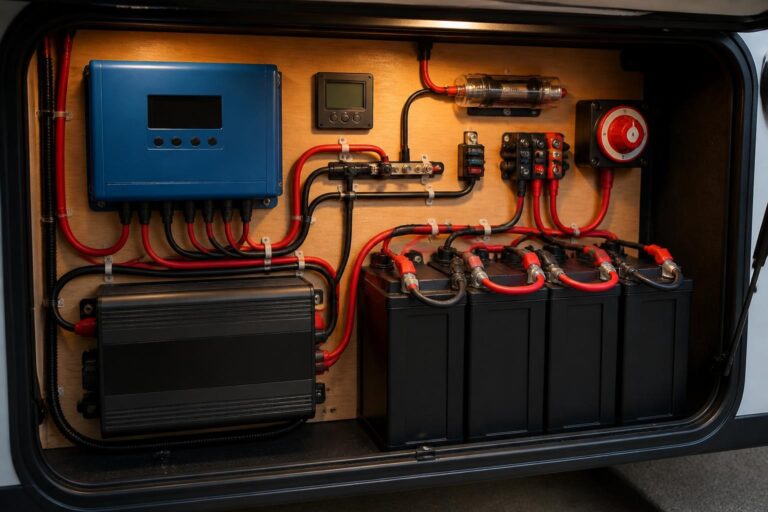
If you are adding solar to an RV, the battery bank is where most of the money and most of the decisions go. The two choices most owners weigh are absorbed glass mat (AGM) lead-acid batteries and lithium iron phosphate (LiFePO4) batteries. Many comparison pages online are written by battery brands. Here we compare the two using manufacturer datasheet numbers and explain the parts of an upgrade people often miss: converter settings, alternator charging and cold weather.
Quick answer
For most RVers who boondock or rely on solar, LiFePO4 is the better long-term choice. A 12V 100Ah lithium battery weighs roughly 27–31 lb versus about 64–67 lb for a comparable AGM, delivers far more usable energy, and is rated for thousands of cycles. AGM still makes sense if you mostly camp on shore power, store the RV in freezing temperatures without a heated battery, or want the lowest upfront cost and no charging-system changes. If you switch to lithium, plan for a lithium-compatible converter profile and, in a motorhome or tow vehicle setup, a DC-DC charger.
Lithium vs AGM at a glance
| Feature | LiFePO4 (12V ~100Ah) | AGM (12V ~100–105Ah) |
|---|---|---|
| Weight | 26.9–31 lb (Renogy Pro, Battle Born, Victron) | 64–67 lb (Lifeline GPL-31T, Trojan 31-AGM) |
| Recommended depth of discharge | Up to 80–100% depending on maker | Average 50% or less (Lifeline) |
| Rated cycle life | 2,500 cycles at 80% DoD to 5,000 at 50% DoD (Victron); 3,000–5,000 (Battle Born) | Typically hundreds of cycles at 50% DoD; up to 900 for premium TPPL AGM (Odyssey) |
| Absorption / float voltage | About 14.2–14.6 V / 13.4–13.8 V | About 14.3–14.4 V / 13.3–13.5 V |
| Round-trip efficiency | About 92% (Victron) | About 80% for lead-acid (Victron) |
| Charging in freezing weather | Blocked or not allowed below about 25–41°F unless self-heated | Allowed with temperature-compensated charging |
| Battery management system | Built-in on drop-in models; some need an external BMS | Not required |
Usable capacity: the number that matters for solar
Two batteries labeled “100Ah” do not give you the same usable energy. Lifeline, a major AGM maker, recommends keeping average depth of discharge at or below 50% of rated capacity to get good life. That leaves about 50Ah of everyday use from a 100Ah AGM, or roughly 600 Wh at 12 V.
LiFePO4 batteries can be cycled much deeper. Battle Born lists 100% depth of discharge as usable, while Victron publishes cycle ratings at 50%, 70% and 80% depth of discharge, and Renogy advises staying within 80%. Even at 80%, a 100Ah lithium battery gives about 80Ah (around 1,000 Wh), so one lithium battery often replaces two AGMs in usable energy.
Discharge rate matters too. Lead-acid batteries lose effective capacity at high current (the Peukert effect). Lifeline gives a Peukert exponent of 1.12 for its AGMs, while Victron recommends setting 1.01 for LiFePO4 in its battery monitors, meaning lithium capacity barely changes with load. That is one reason a microwave or inverter load feels “easier” on a lithium bank.
If you are still working out how much battery and solar you need, start with our RV solar sizing guide.

Weight, space and cycle life
Weight is a real issue in RVs, where cargo capacity is limited. Datasheets show a Battle Born BB10012 at 31 lb and the Renogy 100Ah Pro at 26.9 lb, compared with 64 lb for a Lifeline GPL-31T and 67 lb for a Trojan 31-AGM. Replacing two AGMs with one lithium battery of similar usable energy can save well over 100 lb.
Cycle life is the other big gap. Victron rates its LFP-Smart battery at 2,500 cycles at 80% depth of discharge and 5,000 at 50%. AGM life depends heavily on how deep and how often you cycle and on temperature: Lifeline notes that life roughly halves for every 10°C (18°F) rise in average temperature. For weekend campers who cycle the battery a few dozen times a year, AGM life may be acceptable. For full-timers cycling daily on solar, the difference is large.
Cold weather: lithium’s main weakness
LiFePO4 batteries can discharge in the cold, but charging below freezing can damage the cells. Limits vary by brand, so check yours:
- Battle Born says not to charge below about 25°F unless the battery is internally heated; its BMS blocks charging outside safe limits (Battle Born, May 2026).
- Victron’s LFP-Smart datasheet lists a charge temperature range starting at 41°F (+5°C).
- Renogy’s self-heating model starts heating below 41°F and needs more than 4 A of charge current per battery to power the heater (Renogy FAQ).
AGM batteries can be charged in the cold with temperature compensation, but they lose capacity. Lifeline reports about 60% of capacity at 0°F, and a fully charged AGM resists freezing far better than a discharged one. If you winter camp, either choose heated lithium batteries, mount them inside the heated living space, or accept AGM’s lower capacity.
Charging system changes when switching to lithium
Converter/charger
Many RV converters were designed for lead-acid charging profiles. Some WFCO auto-detect models have a lithium mode that boosts to 14.6 V on a timer, though RV owners have reported units reverting to lead-acid mode (RVtravel.com). Progressive Dynamics sells lithium replacement converter sections. Check your converter’s manual, and set charge voltages to the battery maker’s specification.
Solar charge controller
Your solar charge controller needs a lithium or user-defined profile. Most modern MPPT controllers have one. Read our MPPT vs PWM charge controller guide if you are upgrading at the same time.
Alternator charging
Lithium batteries accept current so readily that direct alternator charging can overload the alternator, especially in motorhomes with short cable runs. Victron describes its Orion-Tr Smart DC-DC charger as controlling that current to protect the alternator, and notes it is “indispensable” with smart alternators (Victron). A DC-DC charger is a common part of a lithium upgrade.
Shop lithium-ready RV gear: [AFFILIATE LINK – LiFePO4 RV battery] · [AFFILIATE LINK – DC-DC charger]
Safety and standards
LiFePO4 is regarded as one of the more thermally stable lithium chemistries, but quality still varies. Look for:
- UN 38.3 transport testing, which US hazmat rules require for lithium batteries (49 CFR 173.185).
- UL 1973 (batteries for stationary and motive auxiliary power) or UL-recognized cells, and UL 9540A fire-propagation test data where available.
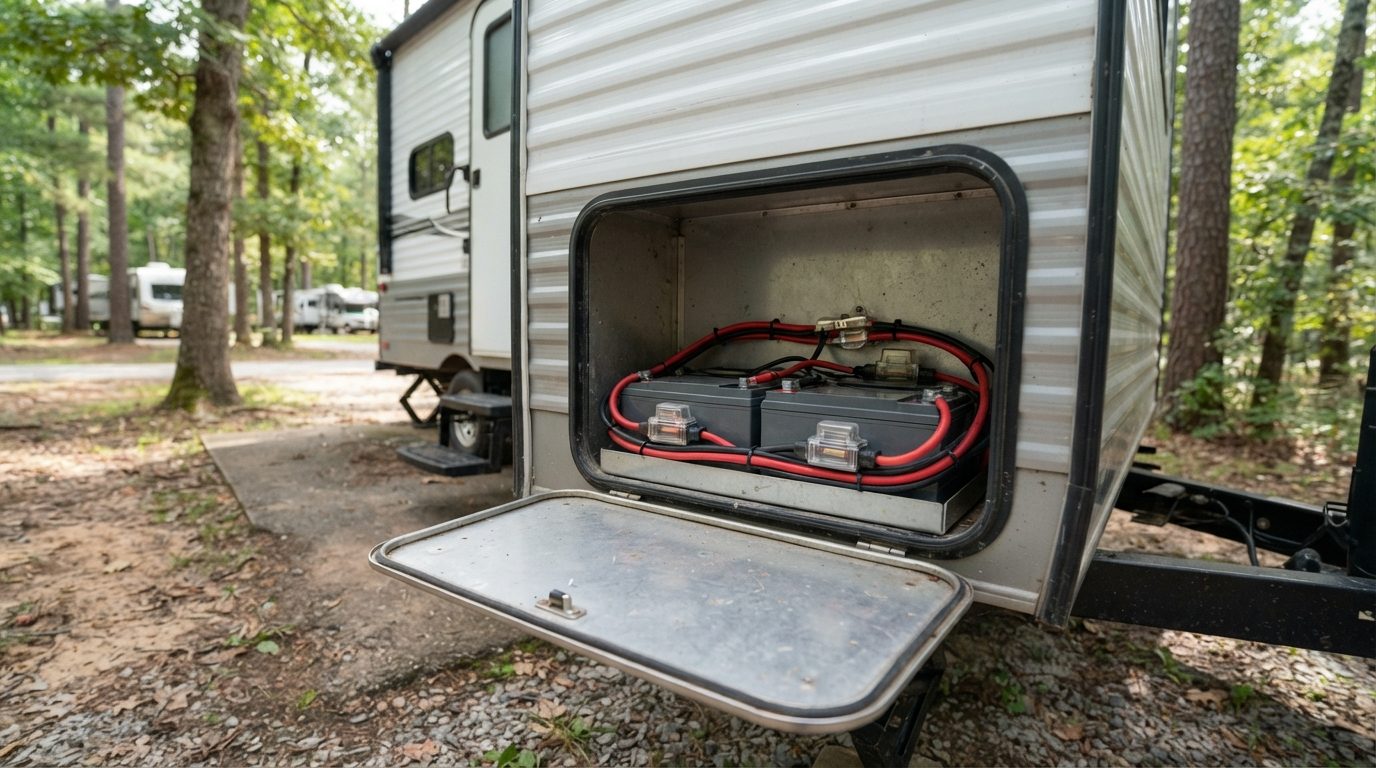
- A battery management system with low-temperature charge protection, and correctly sized fuses and cables close to the battery.
RVIA member manufacturers build to NFPA 1192, NFPA 70 (the NEC) and the ANSI/RVIA low-voltage standard (RVIA). If your upgrade involves 120 V wiring, a new inverter or shore-power changes, have it done or inspected by a qualified RV technician or licensed electrician.
Pros and cons
| Pros | Cons | |
|---|---|---|
| LiFePO4 | Much more usable energy per battery; about half the weight; thousands of rated cycles; higher charging efficiency; stable voltage under load | Higher upfront price; cannot charge below freezing unless heated; may need converter, controller and alternator charging changes |
| AGM | Lower upfront cost; works with existing lead-acid charging; charges in cold weather; no BMS needed | Heavy; only about half the rated capacity is usable for good life; shorter cycle life; slower to recharge from solar |
Lithium vs AGM RV battery FAQ
Can I drop a lithium battery in place of my AGM?
Physically, often yes, since many lithium batteries come in Group 24, 27 or 31 sizes. Electrically, check that your converter, solar controller and any alternator charging can use a lithium profile, and update your battery monitor settings.
Is lithium worth it if I always camp with hookups?
Often not. If the battery mostly sits on shore power and only runs the coach briefly, an AGM may be the more cost-effective choice. Lithium pays off when you cycle the battery regularly on solar.
Can I mix lithium and AGM batteries in one bank?
It is generally not recommended. The two chemistries need different charging voltages and behave differently under load, so one type ends up overcharged or undercharged.
Do I need a DC-DC charger for lithium?
If your batteries charge from a vehicle alternator, a DC-DC charger is strongly recommended to protect the alternator and give a proper lithium charge profile, especially with smart alternators.
Are lithium RV batteries safe?
LiFePO4 batteries with a quality BMS and proper fusing have a good safety record, but choose batteries with UN 38.3 testing and UL-recognized cells or UL 1973 certification, and follow the installation manual.
Conclusion
For solar-powered RV travel, LiFePO4 batteries give you more usable energy, less weight and much longer cycle life than AGM, which is why they have become the default for boondockers. AGM remains a sensible, lower-cost option for hookup campers and for cold storage without heating. Whichever you pick, match your charge settings to the battery’s datasheet, protect your alternator, and size the bank to your real daily energy use.