Last updated: November 20, 2026. Tax rules summarized here are general information, not tax advice.
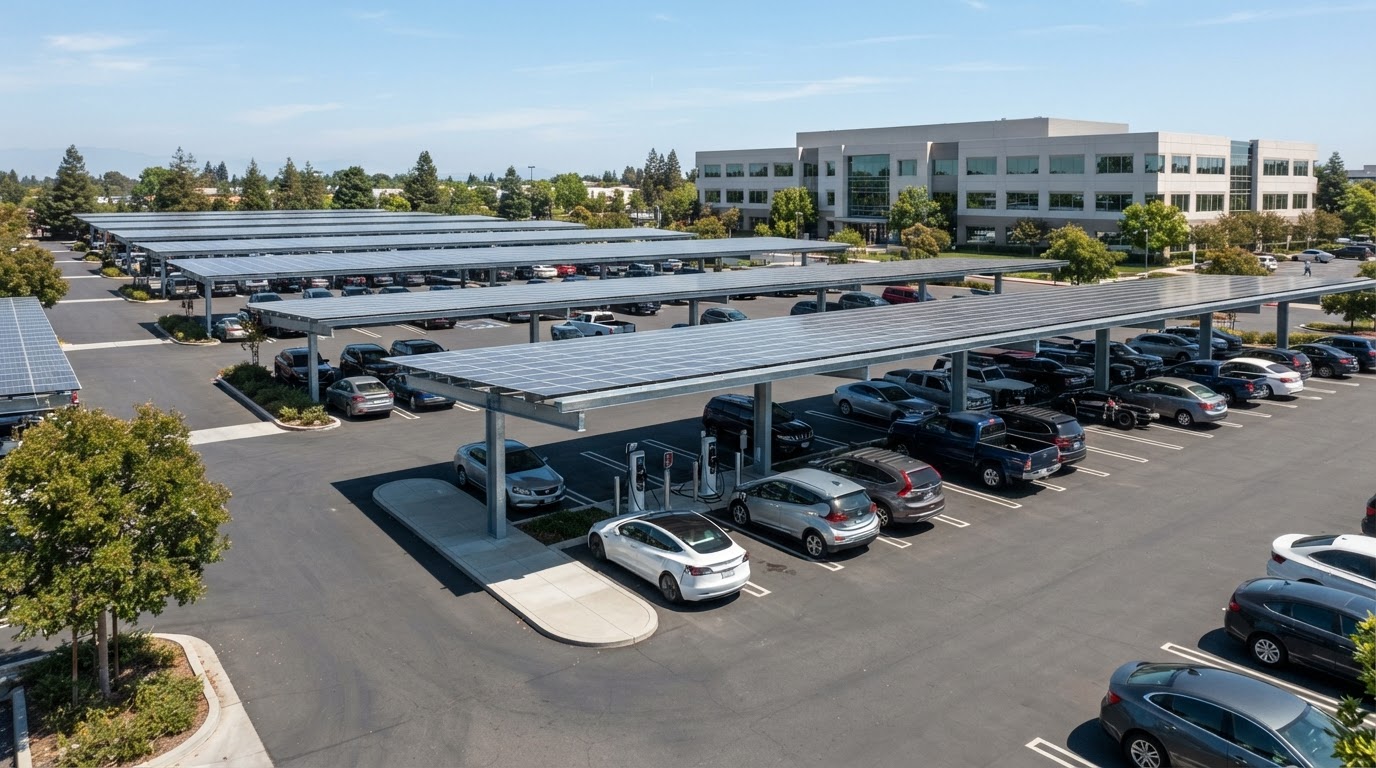
A parking lot is often the biggest unused surface a business owns. A commercial solar carport turns that space into a power plant that also shades cars and can host EV chargers. Carports cost more than rooftop arrays, though, and the federal incentive picture changed sharply under the One Big Beautiful Bill Act. This guide covers what business owners should know before requesting bids: costs, structure types, code issues, incentives and timing.
Quick answer
- What it is: a steel canopy over parking spaces with solar modules as the roof, usually connected to the building’s electrical service.
- Cost: There is no official NREL benchmark for carports. Installer and trade estimates put larger commercial carports around $2.75 to $3.50 per watt, with smaller projects higher, compared with an NREL benchmark of about $1.95 to $1.98 per watt for a commercial rooftop system.
- Incentives (as of November 2026): The Section 48E clean electricity credit is still available to qualifying commercial solar, but projects that began construction after July 4, 2026 must be placed in service by December 31, 2027. 100% bonus depreciation has been restored. The 30C EV charger credit ended for property placed in service after June 30, 2026.
- Best fit: businesses with large, sunny lots, limited or weak roof space, EV charging plans, and high daytime electricity use.
What is a commercial solar carport?
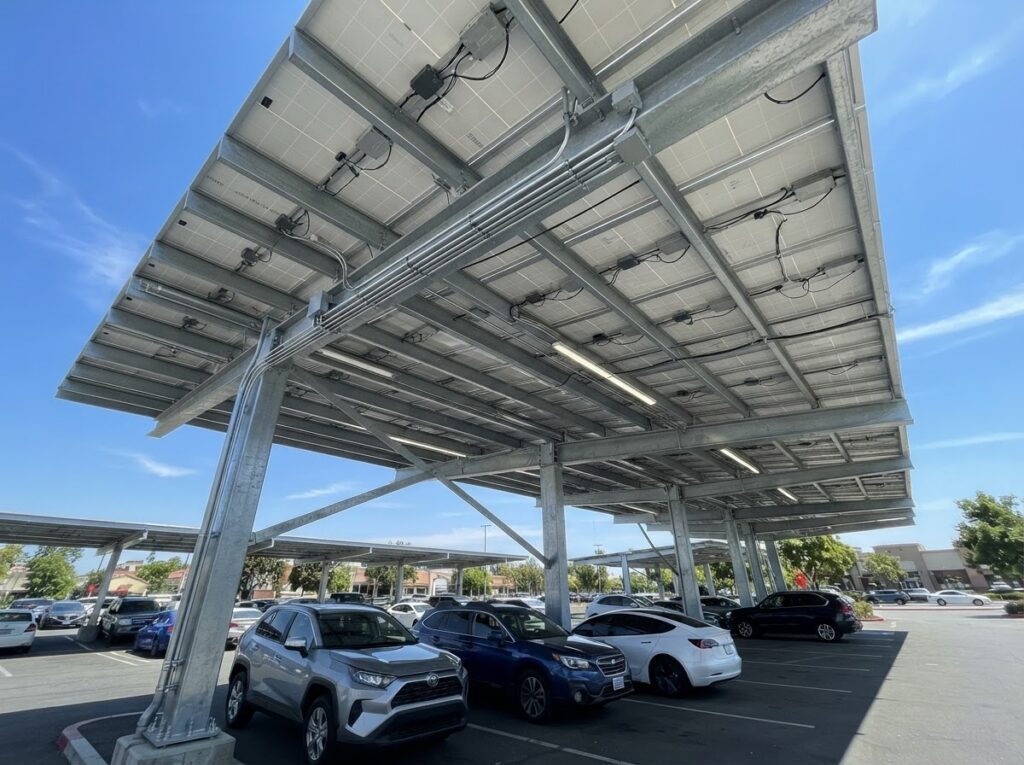
A solar carport (also called a solar parking canopy) is a freestanding structure built over parking spaces, with PV modules mounted on top. Unlike a rooftop array, it doesn’t depend on the condition or strength of an existing roof, and it adds a second benefit: shaded, weather-protected parking.
Common owners include retailers, offices, schools, hospitals, municipalities, car dealerships, warehouses and farms with equipment parking. Systems range from a few dozen kilowatts over a single row to multi-megawatt canopies over large lots.
How much does a commercial solar carport cost?
Carport pricing varies more than rooftop pricing because foundations and steel depend on soil, wind and snow loads, clearance height and layout. Here is what credible sources show:
| System type | Cost per watt (DC) | Source and notes |
|---|---|---|
| Commercial rooftop, 250 kW | $1.95 (MSP) to $1.98 (MMP) | NREL/DOE Q1 2025 benchmark, 2024 dollars |
| Commercial rooftop + storage | $2.96 to $2.98 | NREL/DOE Q1 2025 benchmark |
| Larger commercial carports | About $2.75 to $3.50 | Installer estimate (GreenLancer, Sept 2026) |
| Smaller commercial carports | About $3.75 to $4.50+ | Installer estimate (GreenLancer, Sept 2026) |
| Carport structure alone | About $0.80, up to $1.50+ with options | Solar Builder, vs. $0.15 to $0.25 for ideal ground-mount racking |
What drives the price up or down
- Foundations: Solar Builder describes foundations around 10 feet deep and 3 feet in diameter in good (2,000 psf) soil, while poor soils required 17 to 25 foot footings on some projects. Geotechnical borings and a private utility locate are essential; one project lost a couple hundred kilowatts of layout to a gas line.
- Clearance height: Standard clearance around 14 feet is common; taller designs for buses, trucks or RVs need more steel.
- Layout: Aisle “T” structures shared by two parking rows are generally more economical than perimeter “L” structures.
- Extras: lighting under the canopy, gutters or water management, EV chargers and trenching all add cost.
- Tariffs and equipment: New Section 232 tariffs on imported cells and modules take effect December 4, 2026 (see our weekly solar news roundup). Get module pricing locked in writing.
Types of solar carport structures
| Structure | How it works | Good for |
|---|---|---|
| Single-post “T” cantilever | One row of posts down the middle, canopy extends both ways over two rows of parking | Double-loaded parking aisles; usually the most economical |
| “L” or perimeter cantilever | Posts at one end, canopy cantilevers over one row | Lot edges, single rows |
| Double cantilever / “V” / “checkmark” | Variations that tilt or split the canopy for drainage and appearance | Architectural sites, snow shedding |
| Long-span | Trusses spanning longer distances between posts (Solar Mounts cites 27 to 29 ft post-to-post) | Fewer columns, easier parking and plowing |
Typical tilt angles are low, around 3 to 7 degrees in one manufacturer’s designs, which keeps wind loads manageable but means production is slightly lower than an optimally tilted ground mount.
Codes, engineering and permits
A solar carport is both a building structure and an electrical system, so expect review by your local building and electrical departments (the authority having jurisdiction, or AHJ).
- Structural design: The canopy must be engineered for local wind, snow and seismic loads under the building code your jurisdiction has adopted (typically based on the IBC and ASCE 7). Hire a licensed structural engineer; don’t rely on generic span tables.
- Clearance and fire access: Requirements vary. As one example, the California State University system sets a 7 ft 6 in minimum clear height for usable space under PV structures and requires that fire department access not be impeded (CSU bulletin 23-001).
- NEC Article 690: PV wiring, overcurrent protection and disconnects follow the National Electrical Code (NFPA 70).
- Rapid shutdown: The 2023 NEC added an exception to 690.12 for PV on non-enclosed, detached structures such as standalone carports (North American Clean Energy). A canopy attached to an occupied building may still need it, and not every jurisdiction has adopted the 2023 NEC, so confirm with your AHJ.
- EV chargers: Charging equipment falls under NEC Article 625 and is treated as a continuous load, which affects service and feeder sizing.
- Interconnection: Your utility’s interconnection rules and net metering or net billing tariffs determine how exported power is credited. These vary by state and utility.
All grid-tied and service work should be designed and installed by licensed contractors with proper permits.
Federal incentives for solar carports (as of November 2026)
The rules below come from IRS guidance and professional summaries current as of November 2026. Confirm eligibility with a tax advisor before you sign.
Section 48E clean electricity investment credit
- Deadlines: Under the One Big Beautiful Bill Act, solar projects that began construction after July 4, 2026 must be placed in service by December 31, 2027. Projects that began construction by July 4, 2026 are not subject to that deadline but must meet the continuity safe harbor (generally placed in service by the end of the fourth calendar year after construction began) (The Tax Adviser).
- Beginning of construction: IRS Notice 2025-42 limits most projects starting on or after September 2, 2025 to the physical work test, but solar facilities of 1.5 MW or less (maximum net output) can still use the 5% cost safe harbor. Many carports fall under that size, which can make timing easier.
- Credit rate: a base credit of about 6%, rising to 30% when prevailing wage and apprenticeship requirements are met or the project qualifies for an exemption (SEIA fact sheet).
- Foreign entity (FEOC) rules: material-assistance restrictions apply to projects beginning construction after December 31, 2025. Ask your installer to document equipment sourcing.
For a deeper look, read our guide to the commercial solar tax credit in 2026.
Depreciation
Solar property generally qualifies for 5-year MACRS depreciation, with the depreciable basis reduced by half of the investment credit taken (SEIA). The One Big Beautiful Bill Act restored 100% bonus depreciation for qualifying property acquired after January 19, 2025 (RSM).
EV charger credit (30C)
The IRS says the 30C alternative fuel vehicle refueling property credit “will not be allowed for any property placed in service after June 30, 2026” (IRS). New chargers under a carport no longer get that federal credit, though some utilities and states offer their own charger programs.
State incentives and policies
State programs can make carports more competitive with ground mounts. Two examples:
- New Jersey: Under the ADI program, net-metered non-residential canopy or carport projects under 1 MW earn $110 per SREC-II, compared with $90 for ground-mount; 1 to 5 MW projects earn $100 vs. $85. Check remaining capacity before applying (NJ Clean Energy).
- Maryland: The Maryland Energy Administration has offered Solar Canopy and Dual Use grants (up to $400,000 per canopy in a past round); that window closed, so check for a new round (MEA).
We found no enacted statewide parking-lot solar mandate in the US as of November 2026, although bills have been introduced in some states. Search your state’s incentives on DSIRE.
Pros and cons of commercial solar carports
| Pros | Cons |
|---|---|
| Uses existing paved land instead of roof or open land | Higher cost per watt than rooftop or ground mount |
| Shade and weather protection for customers and staff | Deep foundations and geotechnical risk |
| Natural home for EV charging | Longer permitting and engineering timeline |
| No roof penetrations or roof-age concerns | Low tilt slightly reduces production |
| Visible sustainability signal to customers | Lot disruption during construction |
How to evaluate a solar carport project
- Pull 12 months of utility bills and interval data to understand daytime load and demand charges.
- Check your utility’s tariff for net metering or net billing and export credit rates.
- Get a site assessment: lot layout, shading, soil borings and underground utilities.
- Confirm tax timing with your CPA, including beginning-of-construction and placed-in-service dates.
- Request at least three bids that specify structure type, clearance, module and inverter models, foundation assumptions and warranty terms.
- Model financing options: cash, loan, lease or PPA. Third-party owners may claim the credit themselves.
FAQ
How much does a commercial solar carport cost per watt?
There is no official NREL carport benchmark. Installer estimates put larger commercial carports around $2.75 to $3.50 per watt and smaller ones higher, versus about $1.95 to $1.98 per watt for NREL’s commercial rooftop benchmark.
Do solar carports qualify for the federal tax credit in 2026 and 2027?
Qualifying commercial projects can still use Section 48E as of November 2026, but projects that began construction after July 4, 2026 must be placed in service by December 31, 2027. Confirm details with a tax professional.
Do solar carports need rapid shutdown?
The 2023 NEC exempts PV on non-enclosed, detached structures such as standalone carports from 690.12. Canopies attached to buildings, or jurisdictions on older code editions, may differ; ask your AHJ.
How tall is a commercial solar carport?
Clearance of around 14 feet is common in manufacturer designs, with taller options for large vehicles. Local codes may set minimum clearances.
Can I add EV chargers to a solar carport?
Yes, and it’s a common pairing. Note that the federal 30C charger credit ended for property placed in service after June 30, 2026, so look for state or utility charger incentives instead.
Conclusion
A commercial solar carport costs more per watt than a rooftop array, but it turns otherwise unused pavement into generation, shade and EV charging. The financial case depends heavily on timing: the 48E deadlines, the restored 100% bonus depreciation and state programs like New Jersey’s canopy adder can make or break the numbers. Start with your load data and a site assessment, involve your CPA early, and compare engineered bids from experienced carport installers. Explore more commercial solar guides before you decide.