
Last updated: November 20, 2026.
This article contains affiliate links. If you buy through them, we may earn a commission at no extra cost to you.
The charge controller is the brain between your RV’s solar panels and its batteries. Pick the wrong type and you either leave a lot of solar harvest on the roof or pay for features you’ll never use. This guide explains the real difference between MPPT and PWM charge controllers, when the cheaper PWM option is perfectly fine, and how to size a controller safely for cold mornings and lithium batteries.
Quick answer
- PWM works well for small, simple RV systems where 12-volt-class panels (36 cells, Vmp around 17 to 18 V) charge a 12-volt battery, wired in parallel, often under a few hundred watts.
- MPPT is the better choice for most modern RV setups: larger arrays, residential-style panels (60 cells or more), panels wired in series, cold climates or lithium battery banks. Manufacturers claim MPPT harvests roughly 10% to 30% more in typical conditions, and more in cold weather with a low battery.
- Sizing: the controller’s maximum PV input voltage must exceed your array’s open-circuit voltage at the coldest temperature you’ll see, and its current rating should cover your array’s output at battery voltage.
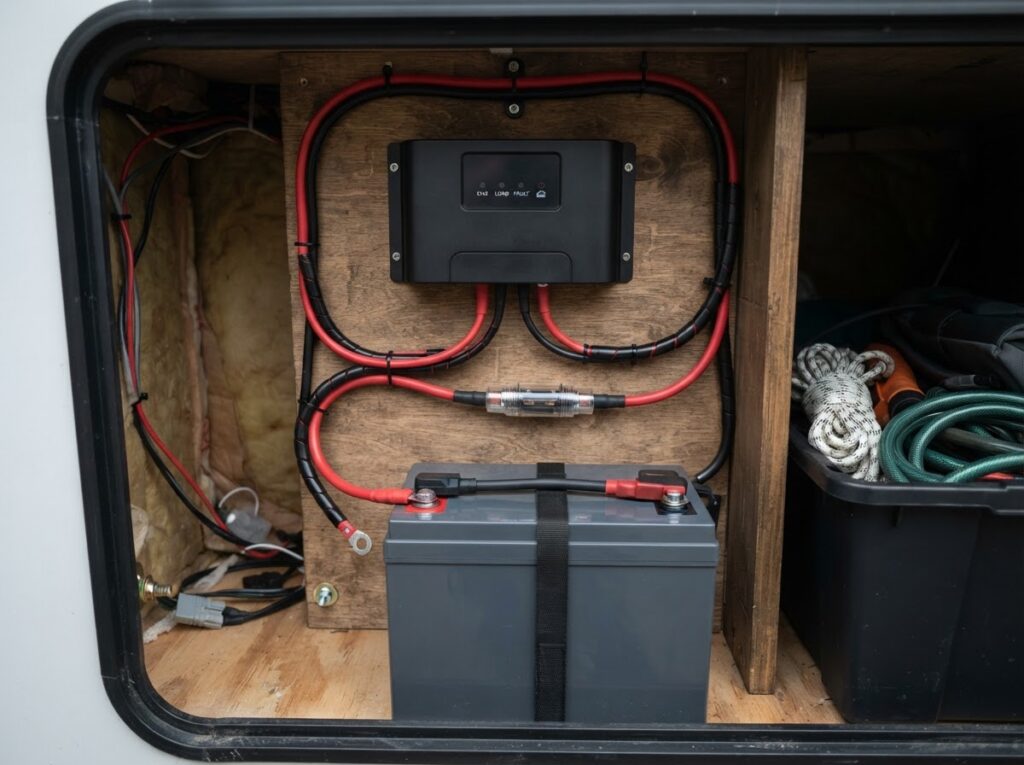
How PWM and MPPT charge controllers work
Every solar panel has a voltage at which it produces maximum power (Vmp). The key difference between the two controller types is whether they let the panel operate there.
PWM (pulse width modulation)
A PWM controller is essentially a fast switch between the panels and the battery. While it’s connected, the panel voltage is pulled down to battery voltage, around 13 to 14.5 V on a 12-volt system, even if the panel’s Vmp is 17 to 18 V. The power represented by that extra voltage is lost (Morningstar).
MPPT (maximum power point tracking)
An MPPT controller is a DC-to-DC converter. It continuously finds the panel’s maximum power point, runs the array at that voltage, and converts the excess voltage into additional charging current (Victron Energy). That’s why an MPPT controller can accept higher-voltage arrays, such as panels wired in series or 60-cell residential modules.
MPPT vs PWM: side-by-side comparison
| Feature | PWM | MPPT |
|---|---|---|
| Panel operating voltage | Pulled down to battery voltage | Held at the panel’s maximum power point |
| Panel compatibility | 12 V-class (36-cell) panels on a 12 V battery | Wide range, including 60/72-cell panels and series strings |
| Typical max PV input (examples) | Renogy Wanderer Li 30A: 25 V | Renogy Rover 30A: 100 V; Victron SmartSolar 100/30: 100 V |
| Harvest gain (manufacturer claims) | Baseline | About 10% to 30% more in many conditions; little or none in hot weather with a full battery |
| Wiring | Usually parallel, heavier cable | Series possible, thinner cable for the same loss |
| Cost and complexity | Lower | Higher |
How much more power does MPPT really give?
Manufacturers give different ranges, and conditions matter:
- Morningstar claims MPPT adds about 5% to 30% depending on climate, with even a basic MPPT delivering about 10% to 15% more charging. It also says PWM can match or beat MPPT on low-power systems, in hot climates, or when batteries usually sit full.
- Victron claims a 10% to 40% advantage when cell temperature is below about 113°F (45°C) or above about 167°F (75°C), or in very low light, and says PWM is fine for small systems when cell temperature sits between those values. (Cell temperature on a sunny roof runs well above air temperature.)
- Blue Sky Energy says that with 36-cell panels, MPPT typically adds 10% to 20% in cool conditions, can add 0% in hot conditions, and may exceed 30% with a discharged battery in freezing weather (SB3000i manual).
The takeaway: MPPT pays off most for winter camping, larger arrays and deeply discharged lithium banks. In a hot desert with a battery that’s usually full, the gap shrinks.
When a PWM controller is enough
- Your array is small, roughly 100 to 200 watts, and mostly tops off batteries while the RV is stored.
- You use 12-volt-class (36-cell) panels wired in parallel to a 12-volt battery.
- You camp mostly in warm weather and your battery is rarely deeply discharged.
- Budget and simplicity matter more than squeezing out every watt-hour.
Morningstar describes 60-cell residential modules (Vmp around 30 V) as “simply not suitable” for PWM on a 12-volt battery, since much of their voltage would be wasted.
When you should choose MPPT
- Your array is more than a few hundred watts.
- You want to wire panels in series to cut cable size or voltage drop on a long run from the roof.
- You use larger residential-style panels, which are often cheaper per watt.
- You camp in cold weather or boondock in winter.
- You have a lithium (LiFePO4) bank that you regularly cycle deeply.
Victron also points out that cable loss rises with the square of current, so doubling array voltage lets you use roughly a quarter of the cable cross-section for the same loss, a real advantage on RV roofs with long cable runs.
How to size an RV solar charge controller
1. Check the maximum PV input voltage (including cold weather)
A panel’s open-circuit voltage (Voc) rises as temperature drops. The National Electrical Code (NEC 690.7) calculates maximum system voltage by correcting Voc to the lowest expected ambient temperature, using the manufacturer’s temperature coefficient or the code’s correction table (EC&M).
Example (illustrative): Two 36-cell panels with a Voc of about 22 V each, wired in series, give 44 V at standard test conditions. Using the NEC table’s factor of 1.16 for temperatures around 1°F (-17°C), the cold Voc is about 51 V. That’s fine for a 100 V MPPT controller but far beyond a PWM controller limited to 25 V. Exceeding the maximum input voltage can destroy a controller, and Victron’s manual states that Voc “can not exceed 100V” on its 100/30 model.
2. Check the charging current
For a quick, conservative estimate, divide array watts by nominal battery voltage. Manufacturers rate controllers at charging voltage, so Victron lists its SmartSolar 100/30 (30 A) at 440 W nominal PV power on 12 V and 880 W on 24 V; if more power is connected, the controller simply limits its output. Renogy rates its 30A Rover MPPT at 450 W on 12 V and its 30A Wanderer PWM at 400 W.
3. Leave headroom
For RVs built with factory solar, the RV industry’s DC standard (adopted by RVIA with mandatory enforcement from September 1, 2026) requires the controller to be listed by a nationally recognized testing lab (for example to UL 1741), with an input voltage rating at least equal to the cold-corrected array Voc and a power rating of at least 125% of array power (RV PRO). DIY installers aren’t bound by RVIA plant inspections, but the same margins are sensible practice. Not sure how many watts you need? Use our RV solar sizing guide first.
MPPT, PWM and lithium (LiFePO4) batteries
- Charge profile: Choose a controller with a lithium or user-programmable profile and set absorption and float voltages to the battery maker’s specs. Victron, for example, provides a lithium preset and disables temperature compensation for LiFePO4.
- Low-temperature charging: Charging lithium cells below freezing can cause lithium plating. Cutoffs vary by product: Battle Born says its BMS blocks charging below 24°F internal temperature (Battle Born). Check your battery’s datasheet and use the controller’s low-temperature cutoff if available.
- PWM with lithium: It can work if the controller has a suitable lithium profile, but you lose the harvest advantage of MPPT.
Solar controller vs. DC-DC charger
A solar charge controller handles power from the panels. A DC-DC charger handles power from the vehicle’s alternator, which matters for lithium banks and smart alternators. Some units combine both: Renogy’s DCC50S, for example, includes an MPPT solar input (50 V max) and alternator charging in one box (Renogy).
Series vs. parallel wiring on an RV roof
- Series: raises voltage and lowers current, allowing thinner wire and earlier charging in low light. Requires MPPT. Shade on one panel can drag down the whole string.
- Parallel: keeps voltage low and current high. Works with PWM and tolerates partial shading (for example from an AC unit or vent) better, but needs heavier cable.
- Series-parallel: a compromise for larger arrays; check your controller’s voltage limit.
Fusing and wire size basics
Victron’s wiring guidance recommends keeping voltage drop under about 2.5%, placing a main fuse close to the battery, and fusing between the PV array and the controller; with lithium banks, at least one fuse must have an interrupt rating at or above the bank’s short-circuit current (Victron Wiring Unlimited). With three or more strings in parallel, check each panel’s maximum series fuse rating. If you’re unsure, have a qualified RV technician or electrician review the design.
Pros and cons
| Pros | Cons | |
|---|---|---|
| PWM | Cheaper, simple, efficient enough for small warm-weather systems | Wastes panel voltage, limited to matched 12 V panels, low input voltage limits |
| MPPT | Higher harvest, accepts series and high-voltage panels, thinner cables, better in cold | Costs more, more settings to configure, must respect max input voltage |
Example controllers to compare
These are examples drawn from manufacturer documentation, not tested recommendations. Confirm current specs and listings before buying.
- Victron SmartSolar MPPT 100/30: 100 V max PV input, 30 A, Bluetooth monitoring. [AFFILIATE LINK]
- Renogy Rover 30A MPPT: 100 V max PV input, lithium compatible. [AFFILIATE LINK]
- Renogy Wanderer Li 30A PWM: 25 V max PV input, budget option for small 12 V systems. [AFFILIATE LINK]
- Renogy DCC50S: combined DC-DC and MPPT solar charger for vans and RVs. [AFFILIATE LINK]
FAQ
Is MPPT worth it for a 200-watt RV system?
It depends. With 12-volt panels in parallel and mostly warm-weather camping, PWM can be adequate. If you camp in cold weather, cycle lithium batteries deeply or plan to expand, MPPT is usually worth the extra cost.
Can I use a PWM controller with lithium batteries?
Yes, if it offers a lithium or adjustable charge profile matching the battery maker’s specs. You’ll still miss MPPT’s extra harvest.
Can I wire RV solar panels in series with a PWM controller?
Generally no. Series wiring raises voltage beyond what PWM controllers can use efficiently, and often beyond their maximum input rating. Series wiring calls for MPPT.
What size charge controller do I need for 400 watts at 12 volts?
400 W divided by 12 V is about 33 A as a conservative estimate. Manufacturers rate controllers at charging voltage, so some 30 A models list 400 to 450 W at 12 V. Check the datasheet, and also confirm the maximum PV voltage for cold weather.
Does MPPT work better in cold weather?
Yes. Panel voltage rises in the cold, and MPPT can convert that extra voltage into current, while PWM wastes it. Manufacturers report the largest MPPT advantage in cold weather with a discharged battery.
Do I need a DC-DC charger if I have solar?
Not necessarily, but it helps if you want to charge a lithium house bank while driving, especially with a smart alternator. Some units combine DC-DC and MPPT solar charging.
Conclusion
For a small, warm-weather RV setup with 12-volt panels, a PWM controller can do the job at a lower price. For almost everything else, including larger arrays, series wiring, residential panels, cold-weather travel and lithium banks, an MPPT controller is the smarter long-term choice. Whatever you buy, size it for cold-weather voltage, leave current headroom, follow your battery maker’s charge settings and fuse the system properly. For the next step, see how panel count affects charging in our RV solar sizing guide.