This article contains affiliate links. If you buy through them, we may earn a commission at no extra cost to you.
If you drive an electric vehicle, adding solar panels can let you “fuel up” with electricity your own roof produces. The question most people ask first is simple: how many panels will it take? The answer depends on three things you can look up: how far you drive, how efficient your EV is, and how much sunlight your location gets. This guide gives you a formula, worked examples and the practical details of charging an EV with solar at home.
Quick answer
- U.S. licensed drivers traveled an average of 13,735 miles in 2024, according to the Federal Highway Administration.
- Using an assumed efficiency of 30 kWh per 100 miles, about 10% charging losses, and an assumed solar yield of 1,400 kWh per kW of panels per year, that driver needs roughly 4,500 kWh a year, or about a 3.2 kW solar array.
- With 400 W panels, that’s about 8 to 9 panels. Depending on your mileage, car and location, the real number could be roughly 5 to 12 or more.
- Run your own numbers with your EV’s rating on FuelEconomy.gov and your location’s solar output from NREL’s PVWatts.
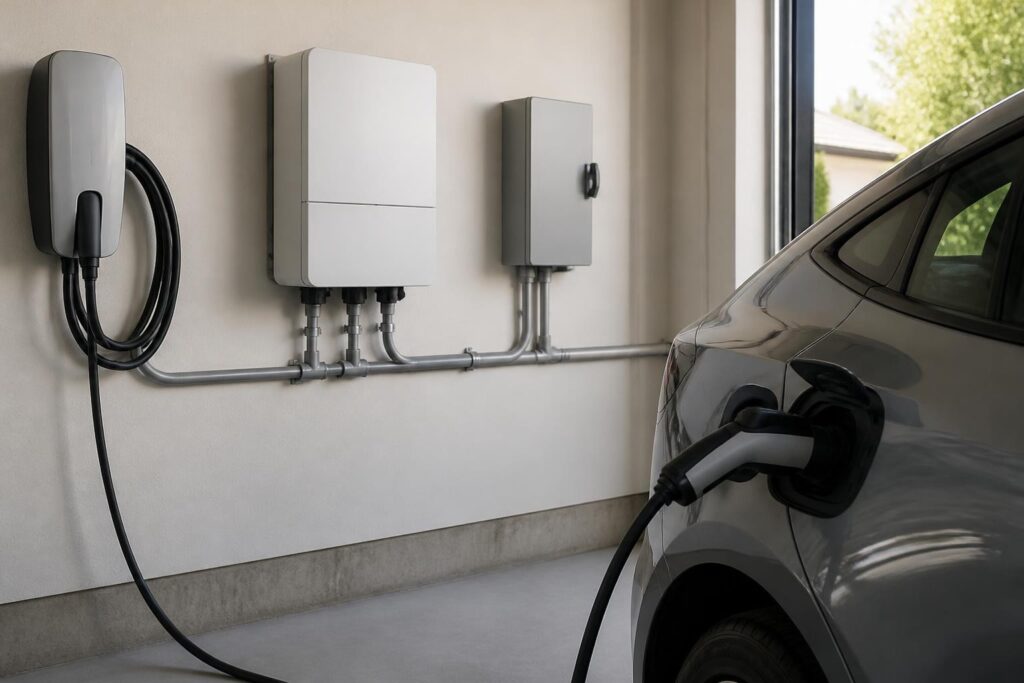
The formula: how many solar panels to charge an electric car
You only need four inputs:
- Annual miles driven (check your odometer or service records).
- EV efficiency in kWh per 100 miles. FuelEconomy.gov lists this for each model; it varies by vehicle, speed and weather.
- Charging losses. Some energy is lost between the wall and the battery. We use 10% as a planning assumption.
- Annual solar yield in kWh per kW of panels at your address, from PVWatts.
Annual EV energy (kWh) = Miles ÷ 100 × kWh per 100 mi × 1.10
Solar array size (kW) = Annual EV energy ÷ Annual solar yield per kW
Number of panels = Array size (W) ÷ Panel wattage
Worked example
Using FHWA’s 13,735-mile average and the assumptions above:
- 13,735 ÷ 100 × 30 = 4,121 kWh at the battery
- 4,121 × 1.10 ≈ 4,530 kWh from the wall
- 4,530 ÷ 1,400 ≈ 3.24 kW of solar
- 3,240 W ÷ 400 W ≈ 8.1, so about 8 to 9 panels
Examples by mileage and sunshine
The table below uses the same assumptions (30 kWh/100 mi, 10% losses, 400 W panels). The solar yield values are illustrative, not data for any specific city; your PVWatts result is what counts.
| Annual miles | EV energy/year | Panels at 1,200 kWh/kW (less sun) | Panels at 1,400 kWh/kW | Panels at 1,600 kWh/kW (more sun) |
|---|---|---|---|---|
| 8,000 | ≈ 2,640 kWh | ≈ 6 | ≈ 5 | ≈ 4 to 5 |
| 13,735 (FHWA avg.) | ≈ 4,530 kWh | ≈ 9 to 10 | ≈ 8 to 9 | ≈ 7 to 8 |
| 20,000 | ≈ 6,600 kWh | ≈ 14 | ≈ 12 | ≈ 10 to 11 |
A more efficient EV (lower kWh per 100 miles) needs fewer panels; a large pickup or SUV usually needs more. Remember these panels are in addition to what you need for the rest of your home’s electricity use.
Can you actually charge your EV directly from the sun?
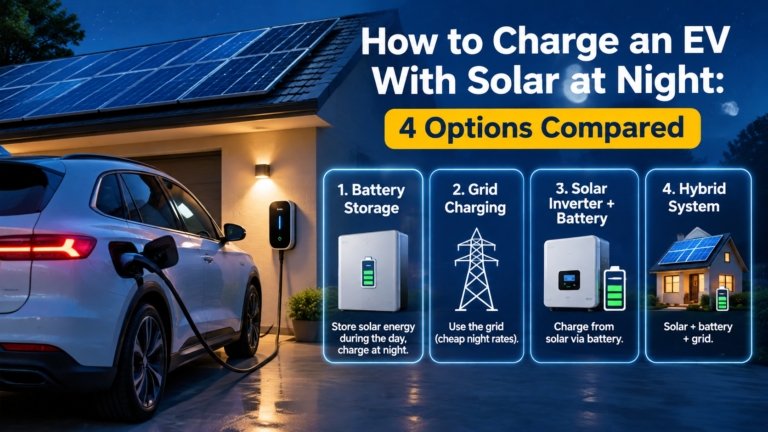
Most home solar systems are grid-tied, which means your car charges from your home’s electrical panel and the grid balances supply and demand. Whether that charging is “solar powered” depends on timing and your utility’s rules:
- Charging during the day (for example, if you work from home) uses solar production directly and avoids buying grid power.
- Charging at night uses grid power. If your utility offers net metering, daytime exports earn credits that offset nighttime charging. Under net billing, exports earn less, so daytime charging or a home battery becomes more valuable.
- Time-of-use rates may make overnight charging cheap or daytime exports valuable, depending on your plan.
Net metering and rate plans vary by state and utility. Check your utility’s tariffs and your state’s rules on DSIRE.
Solar-aware EV chargers
Some Level 2 chargers and home energy management systems can follow your solar output, raising or lowering the charging rate to use surplus solar instead of exporting it. This works best with a compatible inverter or energy monitor. Compare solar-aware Level 2 chargers here [AFFILIATE LINK]. Make sure any charger you buy is safety-certified by a nationally recognized testing laboratory (for example, listed to UL 2594 for EV supply equipment).
Level 1 vs Level 2 charging with solar
| Level 1 (120V) | Level 2 (240V) | |
|---|---|---|
| Typical power | About 1.4 kW to 1.9 kW | Up to about 7.7 kW on a 40 A circuit (32 A × 240 V) |
| Fit with solar | Low power can closely match a small solar surplus | Faster; may draw grid power when the sun can’t keep up |
| Installation | Standard outlet (dedicated circuit recommended) | Dedicated 240V circuit, often a permit and panel capacity check |
The National Electrical Code (NFPA 70) treats EV charging as a continuous load, so the circuit must be rated at 125% of the charger’s current (a 32 A charger needs a 40 A circuit). A licensed electrician should confirm your panel capacity, pull the required permits and perform the installation.
Do you need a home battery?
Not necessarily. With good net metering, the grid acts like a free “battery.” A home battery makes more sense if your utility pays little for exports, if you want backup power during outages, or if you charge mainly at night. Home batteries should be listed to UL 9540. Note that a typical home battery is much smaller than an EV battery, so it can top up your car, not fully refill it every night.
Incentives: what’s available as of November 2026
- The homeowner 30% Residential Clean Energy Credit (25D) ended for expenditures after December 31, 2025, according to the IRS.
- The federal EV charger credit (30C) does not apply to property placed in service after June 30, 2026, under the same law. See the IRS 30C page.
- Many utilities and states still offer EV charger rebates, special EV rate plans or solar incentives. Search your ZIP code on DSIRE and your utility’s website.
Pros and cons of charging an EV with solar
Pros
- Lower per-mile fuel cost over the life of the system, depending on your utility rates.
- More of your driving powered by clean, local electricity.
- Can be paired with a battery for backup and more self-consumption.
Cons
- Upfront cost, with no federal homeowner credit for systems installed in 2026.
- Seasonal swings: winter production is lower in most of the country.
- Savings depend heavily on your utility’s net metering or net billing rules.
For more ideas, see our EV Solar guides, and if you’re planning a complete home system, start with our Home Solar section.
FAQ
How many solar panels does it take to charge a Tesla or other EV?
Use the same formula: annual miles, your model’s kWh per 100 miles from FuelEconomy.gov, and your local solar yield from PVWatts. For an average-mileage driver with our assumptions, it’s about 8 to 9 panels of 400 W.
Can I charge my EV with solar panels during a power outage?
Not with a standard grid-tied system, which shuts down during outages for safety. You need a system designed for backup, usually with a battery and a compatible inverter.
How many kWh does it take to charge an EV?
It depends on battery size and how empty it is. For daily driving, multiply your miles by your EV’s kWh per mile and add a margin for charging losses.
Is it cheaper to charge an EV with solar?
Often, over the long term, but it depends on your system cost, your utility rates and how exports are credited. Compare your utility’s EV rate plan with the cost of the added solar capacity.
Can I add panels later for a new EV?
Often yes, but your inverter, roof space and interconnection agreement may limit expansion. If you expect to buy an EV, tell your installer during the design stage.
Conclusion
For the average American driver, charging an electric car with solar takes a modest array: roughly 3 kW, or about 8 to 9 typical panels, under the assumptions in this guide. Your own number depends on your mileage, your car and your sunshine, and all three are easy to look up. Size the system around your real data, check how your utility credits solar, and have a licensed electrician handle the charger and panel work.