RV Solar Kit Guide: 5 Things to Check Before You Buy
Some links on this page may be affiliate links. Read our affiliatAffiliate Disclosuree disclosure.
A good RV solar kit saves you hours of shopping, but only if it matches what you actually use. Many kits are sized for a “typical” van, and typical rarely means yours. In this guide you will size your system first, then check five things in any RV solar kit before you pay.
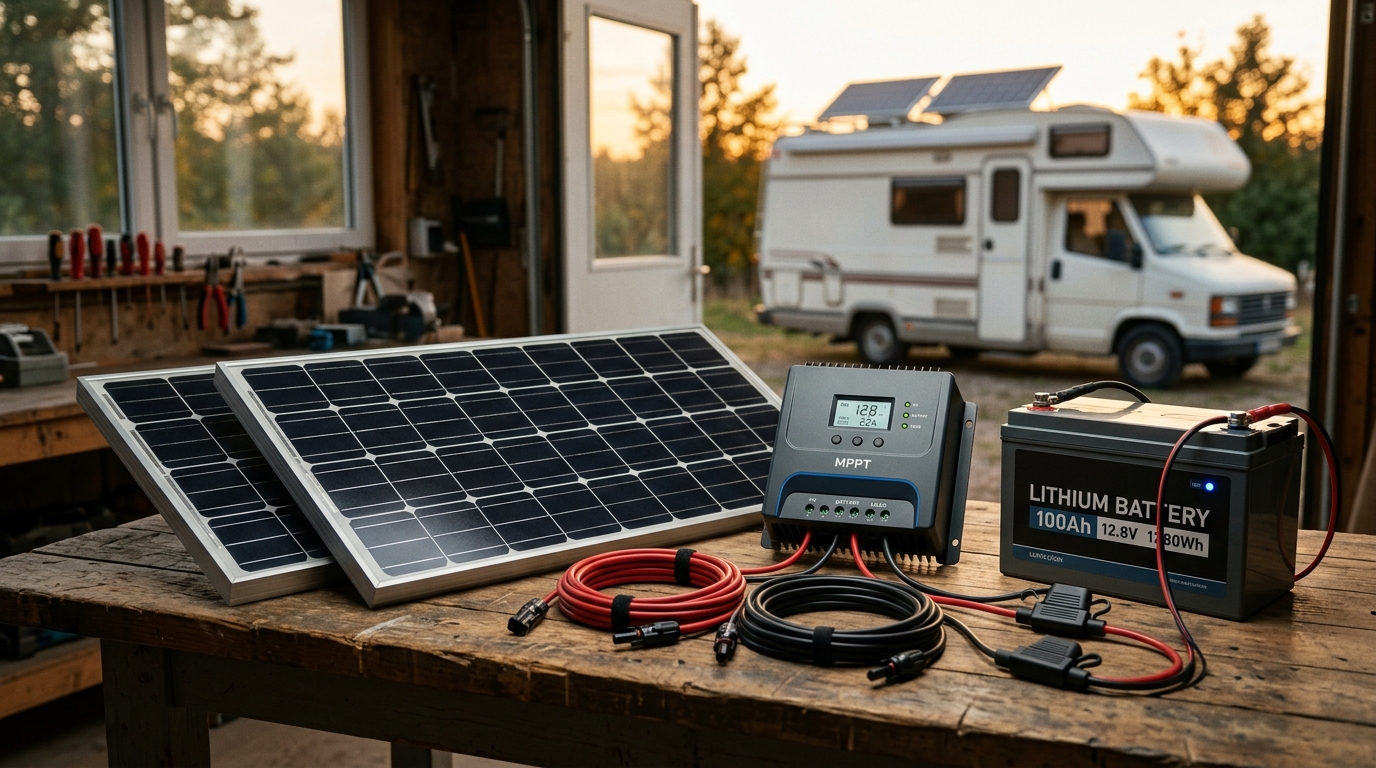
Quick answer: most RV and van systems need between 200 W and 800 W of solar panels. Work out your daily energy use first, then choose a kit with at least that many panel watts, an MPPT charge controller, proper cables and fuses, and check whether a battery is included.
Start With Your Own Numbers
Kit listings are written to sell, not to fit your rig. Before you compare any RV solar kit, you need one number: how much energy you use each day.
- List each appliance and its watts.
- Multiply by the hours you use it per day to get watt-hours (Wh).
- Add everything up.
Then size your panels with this formula:
Daily Wh ÷ peak sun hours × 1.25
The 1.25 covers wiring losses, heat, dust and shade. Our guides use 4 peak sun hours as a safe average. If you want to skip the math, the RV solar calculator adds up your appliances and gives you panel watts, battery size and inverter size, plus a PDF report you can keep.
New to the terms? Read how an RV solar system works first.
5 Things to Check in Any RV Solar Kit
1. Total Panel Watts
Compare the kit’s total panel watts with the number you calculated. A kit that is 30 percent smaller than your result will leave your battery short on cloudy days. A kit that is much bigger may not fit on your roof.
In a van, roof space is usually the real limit. Rigid monocrystalline panels give roughly 19 watts per square foot, so 20 sq ft of free roof holds about 380 W. Measure around vents, fans and racks before you buy.
2. The Charge Controller
The controller sits between the panels and the battery and prevents overcharging. Check two things:
- Type. Choose MPPT for most RV and van builds, especially above about 200 W of panels. PWM can work for a very small 12 V system with one small panel. For more detail, see our guide to MPPT vs PWM.
- Amp rating. The minimum is
panel watts ÷ battery volts × 1.25. For example, 400 W on a 12 V battery needs at least 42 A, so a 50 A controller is the right choice.
Also check the controller’s maximum input voltage. Panel voltage rises on cold mornings, and exceeding the limit can damage the unit.
3. Cables and Connectors
Many kits include short, thin cables to keep the price down. Thin cables cause voltage drop, heat and wasted energy. Aim for less than 3 percent voltage drop, and measure the real distance from your roof to the battery before you decide the kit’s cables are enough.
If your run is long, budget for thicker cable. You will find installation details in our RV solar wiring and installation guides.
4. Fuses and Breakers
Every positive cable needs a fuse or breaker close to its power source. Some kits include them. Many do not. A short circuit on an unprotected cable can melt insulation and start a fire.
Check whether the kit lists fuses, breakers and connectors. For lithium batteries, use a fuse rated for high fault current. A Class T fuse is common. If the listing is vague, ask the seller before you buy.
5. Is the Battery Included?
Many RV solar kits leave out the battery, which is usually the most expensive part of the build. Compare kits by what you will actually need to buy, not only by the headline price.
When you add a battery, the choice is usually lithium (LiFePO4) or AGM:
- LiFePO4: about 80 to 100 percent usable, light, and long lasting. Needs low-temperature protection before charging in freezing weather.
- AGM: cheaper to buy, but you should use only about 50 percent of its capacity, so you need a bigger bank.
Our battery and inverter guides explain how to size each one.
RV Solar Kit Sizes by Budget and Use
Use this table as a starting point. The numbers come from the sizing formula above, at 4 peak sun hours.
| Usage | Daily energy | Panels needed | Min. controller | Kit size to look for |
|---|---|---|---|---|
| Weekend camper: lights, phones, small fridge | 600 Wh | 188 W | 30 A (21 A calculated, 12 V) | about 200 W |
| Part-time traveler: plus laptop and fans | 1,200 Wh | 375 W | 50 A (42 A calculated, 12 V) | about 400 W |
| Full-time: fridge, remote work, water pump | 2,500 Wh | 782 W | 50 A (42 A calculated, 24 V) | about 800 W |
Heavy loads such as an air conditioner, microwave or induction cooktop need a much larger system. A rooftop RV air conditioner commonly draws well over 1,000 W while running, so most small kits are not built for it.
Budget tip: do not compare kits by total price alone. Divide the price by the panel watts to get the cost per watt, then add the cost of anything missing (battery, fuses, longer cable). That is the real price of a working system.
RV Solar Kit or DIY?
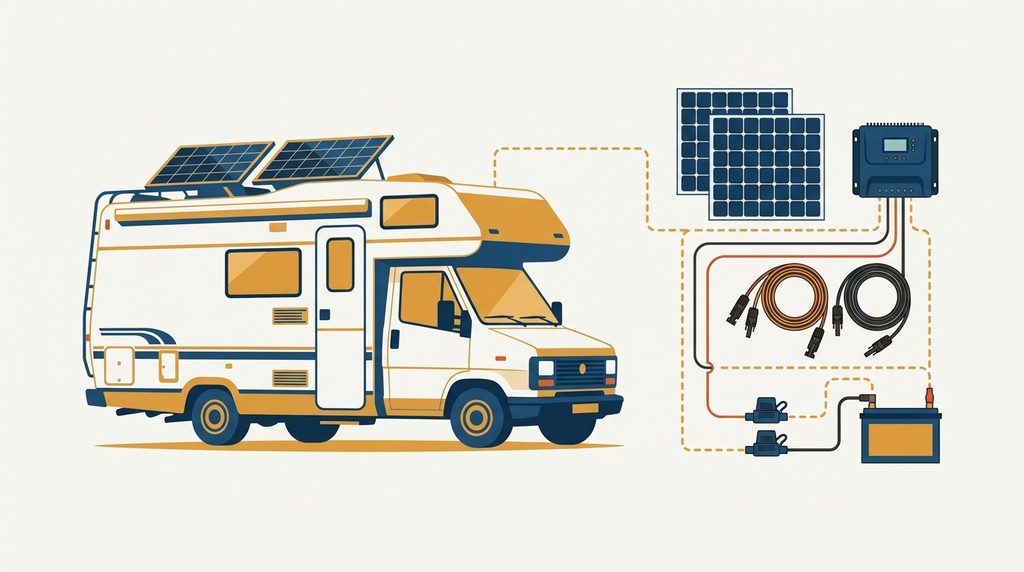
An RV solar kit is the easiest way to start because the parts are matched. Choose one if:
- This is your first solar build.
- You want matched panels, controller and cables.
- Your needs fit a standard size.
Buying parts separately is better if:
- You need a custom roof layout.
- You want a bigger battery or an inverter/charger.
- You plan to expand the system later.
Either way, size the system from your own numbers first.
Common RV Solar Kit Mistakes
- Buying by watts alone. A big panel with a small controller wastes power.
- Assuming a battery is included. Read the contents list line by line.
- Ignoring roof space. Measure first, shop second.
- Skipping fuses. Add proper protection on every positive cable.
- Forgetting inverter surge. Motors and compressors briefly draw several times their running watts.
- Charging lithium below freezing without low-temperature protection.
If you add a large inverter, 120 V wiring or a big lithium bank, hire a qualified installer or electrician. Mistakes at that level can cause fires or injury.
RV Solar Kit FAQ
What is included in an RV solar kit?
Most kits include solar panels, a charge controller, and mounting hardware and cables. Many leave out the battery, fuses and breakers, so read the contents list carefully before you buy.
How much does an RV solar kit cost?
Prices vary widely with panel watts, the controller type and whether a battery is included. Check the current price on the seller’s page, then compare the cost per watt and add anything the kit does not include.
Is an RV solar kit better than buying parts separately?
A kit is simpler and the parts are matched, which suits a first build. Separate parts give you more control for custom roof layouts or future upgrades.
Can I add a battery to an RV solar kit later?
Yes, if the controller supports your battery type and voltage. Check that the controller’s amp rating still suits the battery bank you plan to add.
Next Step
Now you know what to check. The next step is to turn your own appliances into numbers with the RV solar calculator, then compare kits against your result.
This guide is for general education. Electrical work can be dangerous. Follow your local electrical code and the manufacturer’s instructions, and ask a qualified electrician if you are unsure.
rv solar system