
This article contains affiliate links. If you buy through them, we may earn a commission at no extra cost to you.
Home batteries have gone from niche add-on to mainstream: Lawrence Berkeley National Laboratory found that 37% of new residential solar systems were paired with storage in 2025, up from 25% in 2024. But the price picture changed at the start of 2026, when the federal homeowner tax credit ended. This guide explains what a solar battery actually costs today, what still lowers that price, and how to avoid paying for more capacity than you need.
Quick answer
As of mid-2026, EnergySage quote data puts a typical 13.5 kWh home battery at about $15,600 installed before incentives, with whole-home backup (usually two to three batteries) averaging about $34,000. State averages range widely, from roughly $563/kWh to $1,586/kWh (EnergySage, updated July 2026). Homeowners who buy a battery outright can no longer claim the 30% federal Residential Clean Energy Credit (Section 25D), which ended for expenditures after December 31, 2025. State and utility programs, plus leasing or third-party ownership, are now the main ways to cut the cost.
In this guide
- Solar battery cost in 2026
- What drives the price
- Popular home batteries compared
- Tax credits and incentives in 2026
- Codes, permits and safety
- Is a solar battery worth it?
- FAQ
Solar battery cost in 2026
Battery pricing is usually quoted in dollars per kilowatt-hour (kWh) of storage capacity, installed. That number varies more than most people expect, because labor rates, permitting, electrical upgrades and local competition all differ by state. EnergySage’s analysis of quotes from the first half of 2026 shows a typical range like this:
| Backup goal | Typical setup | Approximate installed cost (before incentives) |
|---|---|---|
| Essential loads (fridge, lights, Wi-Fi, some outlets) | 1 battery, 10–13.5 kWh | $5,000–$18,000 |
| Typical single battery | 13.5 kWh | About $15,647 |
| Whole-home backup | 2–3 batteries | About $24,000–$40,000 (average about $34,000) |
| Off-grid home | Large battery bank plus generation | $100,000+ |
Two other data points help put this in context. EnergySage reports that equipment makes up roughly 50–60% of the installed price, with the rest going to labor, design, permits and installer overhead. And Berkeley Lab found that, for cash purchases, adding storage to a new solar system raised the median installed price by about $2.1 per watt of solar capacity in 2025 (note that about 80% of that dataset comes from California).
Retrofit vs. new install: Adding a battery to an existing solar system usually costs more than installing both at once, because the installer may need extra equipment (for example a separate battery inverter) and a second round of permitting and labor.
What drives the price of a home battery
1. Capacity and power
Capacity (kWh) is how much energy the battery stores. Power (kW) is how much it can deliver at once. A battery with plenty of kWh but low kW can run your fridge all night but may not start a central air conditioner or well pump. Large motor loads are often what pushes a household from one battery to two.
2. Partial vs. whole-home backup
Backing up only essential circuits usually means moving them to a critical-loads subpanel, which keeps battery count down. Whole-home backup avoids that rewiring but typically needs more capacity and power. Smart panels or load controllers can sit in between, shedding big loads automatically during an outage.
3. AC-coupled vs. DC-coupled
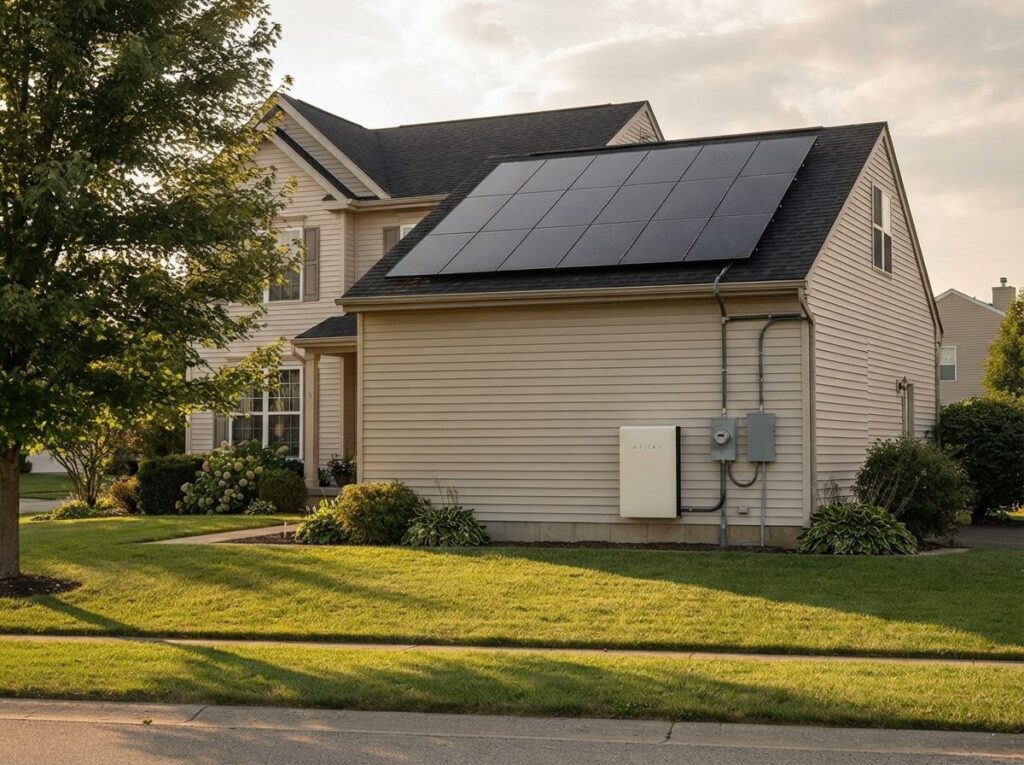
An AC-coupled battery has its own inverter and connects to your home’s AC wiring. It is usually the simplest way to add storage to an existing solar system. A DC-coupled battery shares a hybrid inverter with the solar panels, which avoids an extra conversion step and can be efficient for new installs. Some batteries, such as Tesla Powerwall 3, include a solar inverter. If your chosen battery doesn’t include one, EnergySage notes that a separate inverter can add a couple of thousand dollars.
4. Electrical panel upgrades
Older homes with 100 A service may need a panel upgrade before a battery (and often solar) can be connected. This Old House puts a 200 A panel replacement at about $1,300–$3,000 installed, averaging about $2,150 (updated March 2026). Utility service upgrades can add more.
5. Brand, chemistry and installer
Most new home batteries use lithium iron phosphate (LFP) chemistry, which is valued for thermal stability and long cycle life. Brand averages on EnergySage ranged from about $654/kWh to $1,648/kWh in 2026, so getting at least three quotes matters as much as picking a model.
Popular home batteries compared (datasheet specs)
The table below uses manufacturer datasheet values only. We have not tested these products. Prices are not listed because installed cost depends heavily on your installer and location.
| Battery | Energy | Continuous power | Warranty | Notes |
|---|---|---|---|---|
| Tesla Powerwall 3 | 13.5 kWh | 11.5 kW | 10 years | Built-in solar inverter (up to 20 kW solar input); UL 9540, UL 9540A, UL 1741 listed |
| Enphase IQ Battery 5P | 5.0 kWh usable | 3.84 kVA | 15 years or 6,000 cycles | Modular, AC-coupled; stack units for more capacity |
| FranklinWH aPower 2 | 15 kWh | 10 kW | 15 years or 60 MWh | Up to 15 units per aGate controller; UL 9540, 9540A, 1973, 1741 |
Want to compare current offers? [AFFILIATE LINK – home battery quote comparison]
Solar battery tax credits and incentives in 2026
The federal homeowner credit has ended
Until 2025, homeowners could claim 30% of the cost of a battery of 3 kWh or more under the Section 25D Residential Clean Energy Credit. The One Big Beautiful Bill Act (Public Law 119-21) ended that credit for expenditures made after December 31, 2025 (SEIA; IRS FAQ). As of November 2026, a battery you buy and own is not eligible for a federal homeowner tax credit. Several popular cost pages still mention the 30% credit, so treat those figures with caution.
Leased and third-party-owned batteries
Companies that own a battery and lease it to you, or sell you its services, may still claim the commercial clean electricity investment credit (Section 48E). For energy storage, the law keeps the full credit for projects that begin construction through 2033, phasing down after that (Kirkland & Ellis summary, August 2025). New “foreign entity of concern” sourcing limits also apply. Whether any of that value reaches you depends on the lease terms. Our solar lease vs. buy guide explains the trade-offs.
State and utility battery programs (examples)
Battery incentives vary by state and utility, and budgets open and close. These are examples as of November 2026, not a complete list. Confirm details with the program before you sign a contract.
- California – SGIP: The Self-Generation Incentive Program lists a Residential Solar & Storage Equity budget at $1,100/kWh for eligible households. Check the CPUC SGIP page for which budgets are currently open.
- Massachusetts – ConnectedSolutions: Pays $275/kW for average battery performance during summer grid events (about $1,375 per year for a 5 kW battery), and batteries can qualify for 0% HEAT Loans up to $25,000 (Mass Save).
- Connecticut – Energy Storage Solutions: A new framework from April 1, 2026 offers upfront payments ($130/kWh for grid-edge customers, $30/kWh otherwise) plus 10-year performance payments (Connecticut Green Bank, Feb. 2026).
- Texas – Austin Energy Power Partner Battery: $500 upfront per system plus $75/kW-year for event performance; third-party-owned systems are not eligible (Austin Energy).
- Everywhere else: Search your ZIP code on DSIRE, the national database of state incentives, and ask your utility about virtual power plant (VPP) or demand-response programs.
Codes, permits and safety
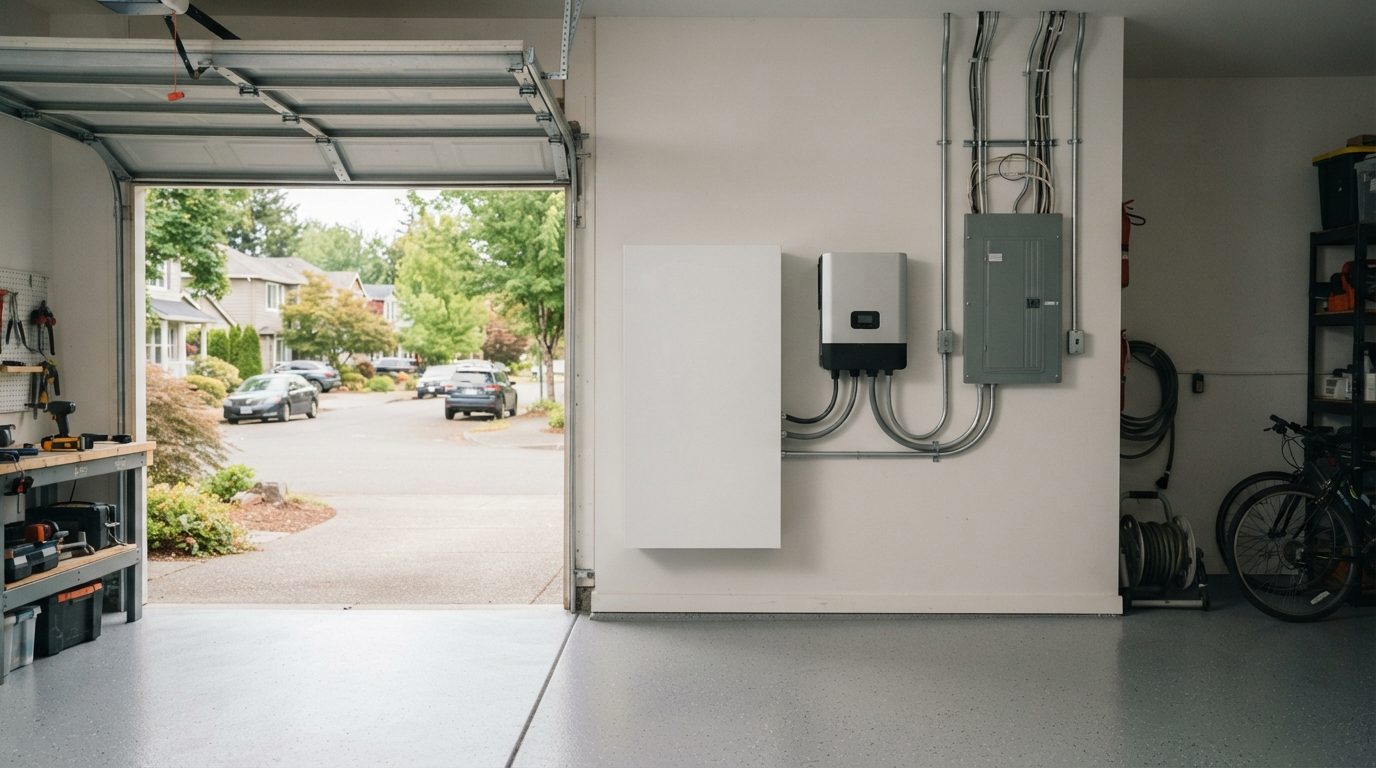
A grid-tied home battery is a permanent electrical installation, and that adds cost you should expect in every quote:
- NEC Article 706 (NFPA 70) covers energy storage systems over 1 kWh. It requires listed equipment, a marked disconnect, and conductor and overcurrent sizing at 125% of rated current (EC&M).
- UL 9540 is the safety standard for the complete storage system; UL 9540A is the fire-propagation test method that code officials use to approve larger installations or closer spacing.
- Residential fire code limits (NFPA 855 and the International Residential Code, as adopted locally) commonly cap individual units at 20 kWh and limit total storage by location, for example 40 kWh in a utility closet or basement and 80 kWh in a garage or outdoors (UL summary of 2021 IRC requirements). Your local edition may differ.
Battery installation should be done by a licensed electrician or certified installer, with a building and electrical permit and utility interconnection approval. This is not a DIY project.
Is a solar battery worth it?
Without the federal credit, the case for a battery depends mostly on three things where you live:
- How your utility pays for exported solar. Where exports earn far less than retail (as under California’s net billing tariff), storing midday solar for evening use is worth more. Where full retail net metering still applies, the bill savings from a battery are smaller.
- Time-of-use rates. A big gap between peak and off-peak prices lets a battery shift energy into expensive hours.
- Outage risk and how much backup matters to you. For households with medical equipment, well pumps or frequent storms, resilience can matter more than payback math.
Pros and cons of adding a home battery
| Pros | Cons |
|---|---|
| Backup power during outages, with solar recharging during the day | High upfront cost, and no federal homeowner credit in 2026 |
| Higher solar self-consumption where export credits are low | Payback can be long where full net metering applies |
| Can earn money in utility VPP programs in some states | Usable capacity slowly declines over the warranty period |
| Quiet, no fuel, no exhaust compared with a generator | Code limits on size and location; may need a panel upgrade |
Our recommendation: Before requesting quotes, write down what you actually need to run during an outage and for how long. That list, not a sales package, should decide between one battery for essential loads and a whole-home system. If you are still choosing panels, see how long solar panels last, since a battery warranty (often 10–15 years) is shorter than a typical panel warranty.
Solar battery cost FAQ
Can I still get a federal tax credit for a home battery in 2026?
Not if you buy it yourself. The 30% Section 25D credit ended for expenditures after December 31, 2025. Third-party owners of leased systems may still claim Section 48E, and some state programs pay for batteries directly.
How much does a Tesla Powerwall 3 cost installed?
It depends on your installer and location. EnergySage reported an average of about $967/kWh for Tesla batteries in its 2026 data; for a 13.5 kWh Powerwall 3 that works out to roughly $13,000 before any local incentives. Get written quotes, since panel work and permits can change the total.
How many batteries do I need to power my whole house?
Many whole-home setups use two to three batteries, but the right number depends on your peak loads (especially air conditioning and well pumps) and how many hours of backup you want. An installer should do a load calculation rather than guess.
Can I add a battery to my existing solar panels?
Usually yes, most often with an AC-coupled battery. Check that your existing solar contract, inverter warranty and utility interconnection agreement allow it, and expect a new permit.
Can a solar battery charge from the grid?
Most can, if the system settings and your utility rules allow it. Some incentive programs restrict grid charging, so check the terms before changing settings.
Conclusion
In 2026, a typical single home battery costs around $15,000–$16,000 installed and whole-home backup roughly twice that, before incentives. With the federal homeowner credit gone, your state, your utility’s export rules and your backup needs now decide whether a battery pays off. Size the system to your real outage needs, compare several quotes, check DSIRE and your utility for programs, and have a licensed installer handle permits and interconnection.
Incentive information is current as of November 2026 and changes often. This article is general information, not tax advice.