Solar panels make power during the day, but most EV drivers plug in after work and charge overnight. The US Department of Energy notes that most EV drivers charge their vehicles overnight at home (AFDC). So how do you charge an EV “with solar” when the sun is down? There are four practical ways, and the best one depends mostly on your utility’s rules.
Quick answer
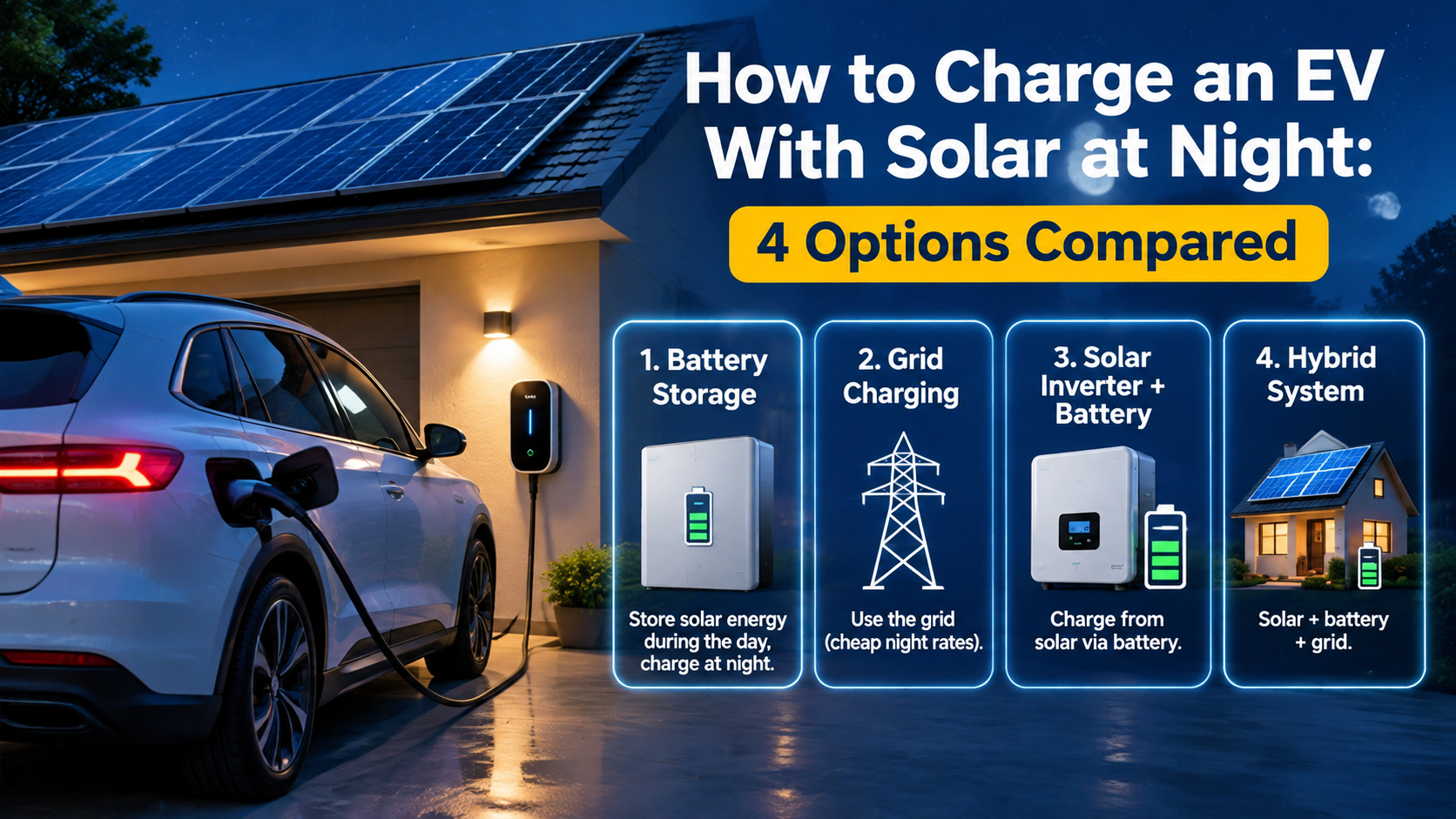
Your panels can’t charge your car directly at night, but you can still use solar energy for night charging by: (1) banking daytime exports as net metering credits, (2) storing solar in a home battery, (3) combining solar with a time-of-use (TOU) rate so you export at high prices and charge at low off-peak prices, or (4) shifting some charging to daytime (weekends, work-from-home days or workplace chargers). If your utility offers retail net metering, option 1 is usually the simplest. Under net billing, a battery or daytime charging becomes more valuable.
Why nighttime solar charging is a timing problem
Rooftop solar output peaks around midday, although timing varies by season, weather, roof orientation, shading and location (Sunrun). Home charging, meanwhile, clusters at night. In a one-week Recurrent study of Tesla owners in June 2024, only about one in four California home charging sessions happened between 10 a.m. and 4 p.m. (Recurrent). The study also saw a spike in sessions starting right at midnight, when many California TOU discounts begin.
The question isn’t whether solar electrons physically reach your car. It’s how to match the energy your panels produce with the energy your car uses, at the lowest cost.
How much energy does night charging need?
The Alternative Fuels Data Center uses an example vehicle that consumes 27 kWh per 100 miles (AFDC). At that rate, a 30-mile daily commute needs roughly 8 kWh at the wheel, plus some charging losses. Your car’s real efficiency may differ, so check its rating on FuelEconomy.gov.
| Charger | Voltage | Typical range added per hour |
|---|---|---|
| Level 1 | 120 V | About 5 miles (assumes 1.9 kW) |
| Level 2 | 240 V (residential) | About 25 miles (units range 2.9–19.2 kW) |
For most commuters, an overnight Level 2 session easily covers daily driving. If you’re sizing an array to cover your EV, see how many solar panels it takes to charge an electric car.
Option 1: Use net metering credits
With net metering, surplus daytime solar flows to the grid and earns bill credits. At night, you draw grid power to charge the car, and those credits offset the cost. Under full retail net metering, this works almost like a free battery.
- Pros: no extra equipment; the simplest setup.
- Cons: only as good as your export rate; under net billing, exports may be credited far below what you pay for night power.
Net metering rules vary by state and utility and have been changing. Check your tariff, and read our guide on how net metering works (draft link; update when published).
Option 2: Store solar in a home battery
A home battery stores excess solar during the day so you can use it later, including for EV charging in the evening (Sunrun). The limit is size. A home battery with 13.5 kWh of usable capacity holds about a quarter of the energy in the 54 kWh EV pack used in AFDC’s example, or roughly 50 miles at 27 kWh per 100 miles (our calculation). Draining it into the car also leaves less for your home’s evening loads and for backup during outages, which some owners prefer to protect (Sunrun).
- Pros: uses your own solar; helpful under net billing or high evening rates; adds backup power.
- Cons: high upfront cost; some energy is lost charging and discharging the battery; a typical home battery covers only part of a full EV charge.
For prices and sizing, see how much a solar battery costs.
Option 3: Pair solar with a time-of-use rate
Time-of-use rates charge different prices depending on when you use electricity (Qmerit). Peak hours are typically 4 to 9 p.m., and off-peak is often 9 p.m. to 6 a.m., though windows vary by utility (Sunrun). Some examples cited by Qmerit (verify current rates with each utility):
- PECO (Pennsylvania): $0.32/kWh on-peak (2–6 p.m.) and $0.053/kWh super off-peak (midnight–6 a.m.).
- PG&E (California): peak 4–9 p.m. daily on its EV plan.
- Reliant (Texas): a plan with free electricity from 8 p.m. to 6 a.m.
If your utility credits exports at the TOU rate in effect, solar exported during higher-priced hours can offset cheap overnight charging. Schedule charging with your car’s app or a smart charger so it starts when the cheapest window opens.
- Pros: low-cost; cheap overnight charging even with modest solar.
- Cons: high peak prices hurt if you can’t shift other loads; benefits depend on how your utility credits exports.
Option 4: Shift some charging to daytime
The most direct way to use solar is to charge while it’s producing. Sunrun suggests midday charging, typically 10 a.m. to 2 p.m., to use solar straight from your panels. You don’t need to charge every day: if you work from home some days, or the car sits in the driveway on weekends, top it up then. A solar-aware EV charger can adjust charging speed to match surplus solar. Workplace Level 2 charging is another daytime option; Recurrent argues employers should offer banks of Level 2 chargers (Recurrent).
The four options compared
| Option | Extra equipment | Works best when | Main drawback |
|---|---|---|---|
| Net metering credits | None | Retail-rate net metering | Weak under net billing |
| Home battery | Battery system | Low export credits, high evening rates, backup needs | Cost and limited capacity |
| Time-of-use rate | Smart scheduling (car app or charger) | Big gap between peak and off-peak prices | Peak-hour costs for other loads |
| Daytime charging | Optional solar-aware charger | Car is home during sunny hours | Depends on your schedule |
Installation and safety notes
- The NEC treats EV charging as a continuous load, and Article 625 covers most charging-equipment requirements (AFDC).
- Permits may be required, and many areas require a site plan before installation (AFDC).
- Outdoor chargers need outdoor-rated equipment (AFDC).
- Have a licensed electrician check your panel capacity before adding a Level 2 charger, a battery, or both.
- Use UL-listed chargers and, for batteries, systems listed to UL 9540.
A note on incentives (as of November 2026)
The homeowner Residential Clean Energy Credit (Section 25D) no longer applies to solar or batteries placed in service after December 31, 2025 (Electrek). Some utilities and states offer EV rates, charger rebates or battery programs; check your utility and DSIRE. If you’re interested in using your car’s battery to power your home, see our guide to vehicle-to-home charging.
FAQ
Can solar panels charge an EV directly at night?
No. Panels produce no meaningful power after dark. You need grid credits, a battery or a rate plan to use daytime solar value at night.
Is it worth buying a home battery just to charge my EV?
Usually only if your export credits are low, evening rates are high, or you also want backup power. Compare the battery cost with the savings over cheap off-peak grid charging.
Is Level 1 charging enough with solar?
For short commutes, possibly. AFDC says 8 hours at 120 V can replenish about 40 miles for a mid-size EV.
What’s the cheapest way to charge overnight with solar?
Often a TOU or EV rate plan combined with net metering or net billing credits, with charging scheduled for the cheapest window. It depends on your utility’s tariff.
Will charging at night reduce my solar savings?
Under retail net metering, little. Under net billing, it can, because you export at a low value and buy back at a higher one.
Conclusion
Charging an EV with solar at night comes down to moving solar value from noon to midnight. Net metering does it for free where it’s still generous; time-of-use rates do it cheaply; a battery does it directly but at a cost; and daytime charging skips the problem entirely. Start by reading your utility’s tariff, then pick the mix that fits your schedule and budget.