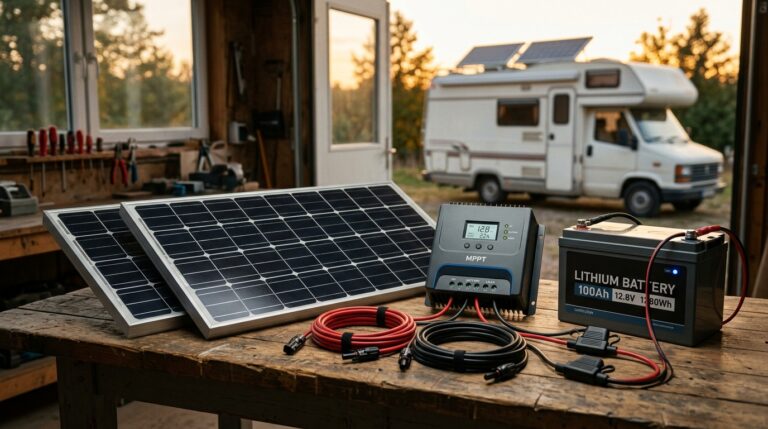
Best Solar Generator for RV (2026): Sizing Guide & Top Picks
A solar generator for RV use is not a generator in the traditional sense. It is a portable power station (a big lithium battery with an inverter) paired with solar panels. There is no fuel, no noise, and no fumes, which is why more RVers are swapping gas generators for solar-powered setups every year.
The hard part is choosing the right size. Buy too small and your fridge dies on day two. Buy too big and you overspend by hundreds of dollars. This guide shows you how to size a solar powered generator for your RV, what to look for, and which capacity tier fits your travel style.
What Is a Solar Generator for an RV?
A solar generator has three parts:
- Battery (power station): stores energy, measured in watt-hours (Wh).
- Inverter: converts battery power to 120V AC for your appliances, rated in watts (W).
- Solar panels: recharge the battery from the sun, rated in watts.
Two numbers matter most: capacity (Wh) tells you how long you can run your devices, and inverter output (W) tells you what you can run at the same time.
How Big a Solar Generator Does Your RV Need?
Start with your daily energy use. Add up each appliance (watts × hours used per day). Here is a typical example for two people:
| Appliance | Power | Daily use | Energy per day |
|---|---|---|---|
| 12V compressor fridge | ~50 W (avg.) | 24 h cycling | ~400 Wh |
| LED lights | 30 W | 5 h | 150 Wh |
| Laptop | 60 W | 4 h | 240 Wh |
| Phones and devices | 20 W | 3 h | 60 Wh |
| Vent fan | 30 W | 8 h | 240 Wh |
| TV | 100 W | 3 h | 300 Wh |
| Coffee maker or microwave | 1,000 W | 10 min | ~170 Wh |
| Total | ~1,560 Wh |
These are estimates. Real numbers vary by appliance, so check the label on yours or use our Appliance Load Calculator to get your own figure.
Rule of thumb: multiply your daily total by 1.2 to cover inverter losses. In this example, 1,560 Wh × 1.2 ≈ 1,900 Wh per day.
Capacity tiers by travel style
| Your style | Daily need | Battery capacity | Inverter output |
|---|---|---|---|
| Weekend camper, lights, phones, small fridge | 500–1,000 Wh | 500–1,000 Wh | 1,000–1,500 W |
| Full-time couple, no air conditioning | 1,500–2,500 Wh | 2,000–3,000 Wh | 2,000–3,000 W |
| Heavy use, induction cooktop, extended boondocking | 3,000+ Wh | 3,500 Wh+, expandable | 3,000 W+ |
How Many Solar Panels Do You Need?
Panels decide how fast you recharge. A simple estimate: panel watts × peak sun hours × 0.75 (real-world efficiency).
With 400 W of panels and 4 peak sun hours: 400 × 4 × 0.75 = ~1,200 Wh per day. To fully cover the 1,900 Wh example above, you would need roughly 600 W of panels, or you can top up occasionally from your vehicle or shore power.
Peak sun hours vary by region and season. Winter in the north can drop you below 2 hours, so size for your worst month, not your best.
Best Solar Generators for RV by Category
Editor note before publishing: pick one product per category, verify current specs and prices on the manufacturer page, and add your affiliate links. Brands that dominate Google for this keyword include EcoFlow, Goal Zero, Bluetti, and Jackery.
Best for weekend trips (about 1,000 Wh)
Pick: [INSERT PRODUCT + AFFILIATE LINK] Powers a fridge, lights, and electronics for a night or two. Light enough to carry. Check that it has pass-through charging.
Best for full-time RVers (about 2,000–3,000 Wh)
Pick: [INSERT PRODUCT + AFFILIATE LINK] The sweet spot for most people. Enough capacity for a day of normal use, with an inverter that handles a microwave or coffee maker.
Best expandable system (3,500 Wh and up)
Pick: [INSERT PRODUCT + AFFILIATE LINK] For long stays off-grid. Look for expansion batteries, a 30 amp output, and a high solar input rating.
Best budget option
Pick: [INSERT PRODUCT + AFFILIATE LINK] Good for beginners who want to test solar before investing in a larger system.
Solar Generator for a 30 Amp RV
A 30 amp RV can draw up to 3,600 W (30 A × 120 V) at full load. A portable power station rarely matches that, so check three things:
- Output rating: the inverter must handle the loads you run at once. Running the roof air conditioner (often 1,300–1,800 W) leaves little room for anything else.
- 30 amp compatible outlet: some stations have a TT-30 or L5-30 output made for RVs. Others need an adapter.
- Safe connection: never connect a power station to your RV by backfeeding a plug. Use a rated cable, or a transfer switch or the manufacturer’s recommended connection, and have an electrician check it if unsure.
Realistic expectation: a single 3,000 Wh station can run the air conditioner for only a short time. If AC is a must, plan for a larger battery bank or expect to run it mainly while driving or on shore power.
Solar Generator vs. Permanent RV Solar Setup
| Solar generator (portable) | Permanent roof system | |
|---|---|---|
| Setup | Plug and play | Installation, wiring |
| Cost | Higher per Wh | Lower per Wh |
| Flexibility | Use at home, camping, outages | Fixed to the RV |
| Panels | Foldable, placed in the sun, even when you park in shade | On the roof, fixed angle |
| Best for | Renters, part-time RVers, backup power | Full-timers and long-term use |
If you travel often and want one system for the RV and for home backup, a portable station is hard to beat. If you live in your RV year-round, a permanent system usually costs less over time.
Common Mistakes to Avoid
- Sizing by watts only. Watts tell you what you can run; watt-hours tell you for how long.
- Ignoring solar input limits. A big battery with a low solar input rating recharges slowly.
- Forgetting shade. Trees and the RV itself block panels. Portable panels help you chase the sun.
- Underestimating the fridge. It runs all day, so it often dominates your energy budget.
FAQ
What size solar generator do I need for my RV?
Most two-person RV setups without air conditioning need 2,000–3,000 Wh. Add up your daily appliance use, multiply by 1.2, and choose a battery that covers it. Our calculator does this for you.
Can solar panels charge a generator for an RV?
Yes. A solar generator is exactly that: a power station you charge with solar panels. Many can also charge from shore power or your vehicle.
Does a solar generator make sense for an RV?
For most campers, yes. It is quiet, fuel-free, and works at home during outages. It makes less sense if you need to run air conditioning for many hours daily without any other charging source.
Is solar really better than a gas generator for an RV?
Solar is quieter, cleaner, and has almost no running costs. Gas generators win on raw output and on cloudy weeks. Many RVers use solar as the main source and keep a small generator as a backup.
What is the best solar generator for your RV?
There is no single best. The right model matches your daily watt-hours and your biggest appliance. Use the tiers above as a starting point.
Final Thoughts
A good solar generator for RV travel starts with an honest energy budget. Calculate your daily use, add a safety margin, and pick the capacity tier that fits. Ready to size yours? Try the Appliance Load Calculator and then browse more guides in our RV & Van Solar section.