LiFePO4 Batteries for Solar Energy Storage: Buyer's Guide for Vans, RVs and Off-Grid
By a working solar technician · Batteries & Inverters · 9 min read
LiFePO4 batteries for solar energy storage have become the standard for camper vans, RV conversions and off-grid systems. They are lighter, last far longer and give you more usable power than lead-acid. This guide explains how to choose, size and protect a LiFePO4 battery bank, from a technician who installs and repairs these systems.
What is a LiFePO4 battery?
LiFePO4 stands for lithium iron phosphate (LiFePO4). Unlike the NMC lithium-ion cells found in laptops and many electric vehicles, this chemistry is very stable thermally and chemically. The risk of thermal runaway is far lower, which is one reason it suits vehicles and living spaces.
In daily use you get a flat discharge voltage (close to 12.8V for a 12V battery, or 25.6V for 24V, until near the end of the cycle), about a third to half the weight of lead-acid, and a much longer life.
LiFePO4 vs lead-acid batteries
Here is how a typical LiFePO4 battery compares with an AGM or gel lead-acid battery in real use:
| Feature | Lead-acid (AGM / gel) | LiFePO4 |
|---|---|---|
| Usable capacity (depth of discharge) | About 50% | 80% to 100% |
| Cycle life | About 300 to 500 cycles | About 3,000 to 5,000+ cycles |
| Weight per 100Ah (12V) | About 28 to 32 kg (60 to 70 lb) | About 10 to 13 kg (22 to 28 lb) |
| Round-trip efficiency | About 80% to 85% | About 95% or more |
| Charging speed | Slow (the last 20% takes hours) | Fast: a full charge in a few hours with a high-current charger |
Figures are typical values. Check the datasheet of the exact battery you plan to buy.
How to size a LiFePO4 battery bank
Correct sizing keeps you from running out of power on a cold night off-grid. It starts with your daily energy use in watt-hours (Wh).
- List your loads: 12V compressor fridge, LED lights, phone chargers, water pump, laptop.
- Multiply each device's watts by the hours it runs per day, then add them up.
- Add 20% to 30% as a safety margin, especially if you use an inverter, which adds conversion losses.
- Choose your days of reserve: 1 to 3 days without sun is a common range.
Example: 1,200 Wh per day with 2 days of reserve is 2,400 Wh. 2,400 ÷ 10.24 ≈ 235Ah, so a 250Ah to 300Ah bank gives you some margin. The 0.8 keeps the battery away from a full 100% discharge.
To see how your panels and battery behave over a day, use our camper van solar simulator.
LiFePO4 battery price and lifespan
Expect to pay roughly $300 to $600 for a quality 12V 100Ah LiFePO4 battery, against about $150 to $250 for AGM. Prices vary by brand and features, so treat these as typical ranges.
The picture changes when you count the cost per cycle:
- An AGM battery under heavy off-grid use often needs replacing every 2 to 3 years.
- A quality LiFePO4 battery can last 10 years or more, often with a 5 to 10 year warranty, and many models are rated for 3,000 to 6,000 cycles to 80% capacity.
Over the long run, lithium usually costs less per usable watt-hour. Planning a complete build? See what a professional camper van power system includes.
12V, 24V or 48V: which battery system?
- 12V: best for smaller vans, simple builds and loads under about 1,000W to 1,500W. Higher current means thicker cables.
- 24V: a good middle ground for larger vans and small off-grid cabins. It halves the current compared with 12V, so cables can be smaller and lighter.
- 48V: for large expedition vehicles, converted buses and off-grid homes with continuous loads above about 3,000W. Wiring losses are lowest here.
Cold weather charging for LiFePO4 batteries
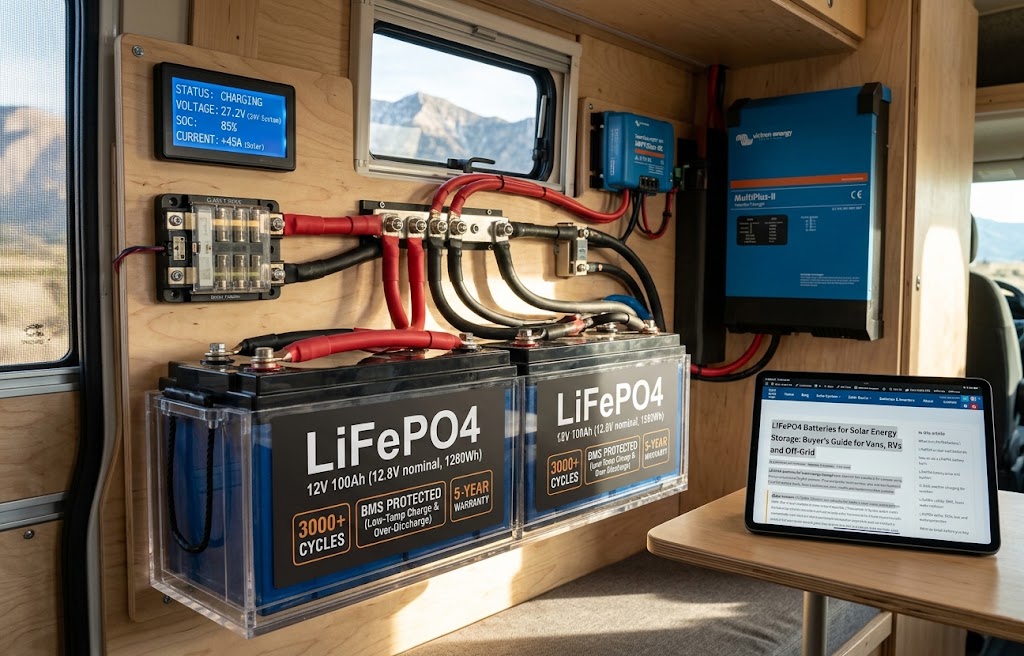
- Choose a battery with low-temperature charge protection in its BMS (Battery Management System).
- If you travel in freezing climates, pick a model with built-in heating pads, or install the batteries inside the heated living space rather than in an uninsulated gear bay.
LiFePO4 safety: BMS, fuses and water protection
- BMS: the battery's brain. It protects against overcharge, over-discharge, short circuits and extreme temperatures. Never buy a LiFePO4 battery without an integrated BMS.
- Fusing: lithium batteries can deliver very high short-circuit currents that melt cables. Install a correctly rated fuse (such as a Class T or Mega fuse) as close as possible to the positive terminal.
- Moisture and water: van compartments see condensation and leaks. Keep the enclosure dry, secure and ventilated. Read our guide on RV battery water damage.
What to check before you buy
- Built-in BMS with low-temperature charge protection.
- Usable capacity and cycle rating clearly stated on the datasheet.
- Continuous discharge current that matches your inverter and loads.
- Warranty length and the maker's support record.
- Series and parallel limits allowed by the manufacturer.
- Water resistance (IP rating) if the battery sits in a damp area.
FAQ
Can I replace a lead-acid battery with a LiFePO4 battery?
In most cases, yes. The size and nominal voltage (12.8V for a 12V LiFePO4) are similar. But your shore charger, alternator (DC-DC) charger and solar charge controller must have a lithium charge profile, with absorption around 14.2V to 14.6V and no equalization stage.
Do I need to fully discharge a LiFePO4 battery before recharging it?
No. LiFePO4 batteries have no memory effect. You can top them off whenever power is available, even from a partial discharge.
Can I wire LiFePO4 batteries in series?
It depends on the manufacturer. Some 12V models allow series wiring up to 24V or 48V, while others forbid it. Always check the manual before connecting units in series.
How long does a LiFePO4 battery last?
Many quality models are rated for 3,000 to 6,000 cycles to 80% capacity, which can mean 10 years or more of regular use. Check the datasheet and the warranty for the exact rating.
How big a LiFePO4 battery bank do I need for a camper van?
Most vans run on 100Ah to 300Ah at 12V. Multiply your daily watt-hours by the days of reserve you want, then divide by 12.8V and the usable fraction of the battery. Use the formula above or our simulator.
Next steps
On a tighter budget? Browse our RV and van solar kits and budget builds. Not sure how much solar you need? Try the camper van solar sizing simulator.