Is a $150,000 Custom Camper Van Worth It? A Solar Technician's View on the Power System
By Hassan Assakour · Solar Technician · RV & Van Solar · 7 min read
When people look at a $150,000 custom camper van, they notice the sleek cedar ceiling and handcrafted cabinetry. As a professional solar technician, I look at one critical component first: the custom camper van power system.
Your off-grid electrical build decides whether you enjoy sustainable comfort in the wild or spend your travel days hunting for campgrounds with shore power hookups. So, is a $150k camper van power system truly worth the investment? Let's analyze what you're actually paying for beneath the surface.
What does a $150K camper van solar system look like?
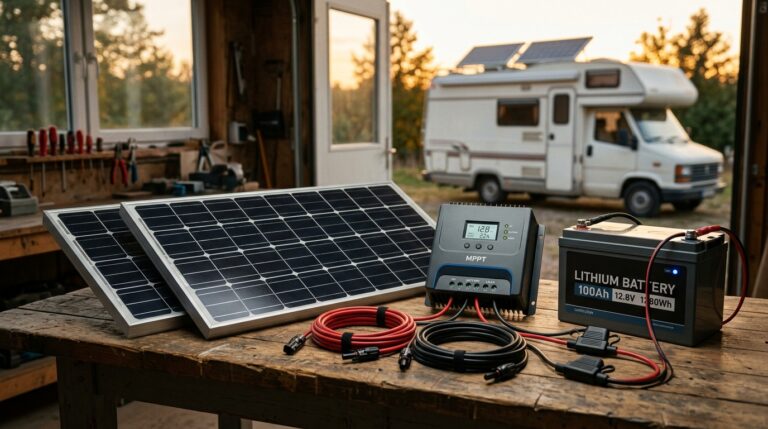
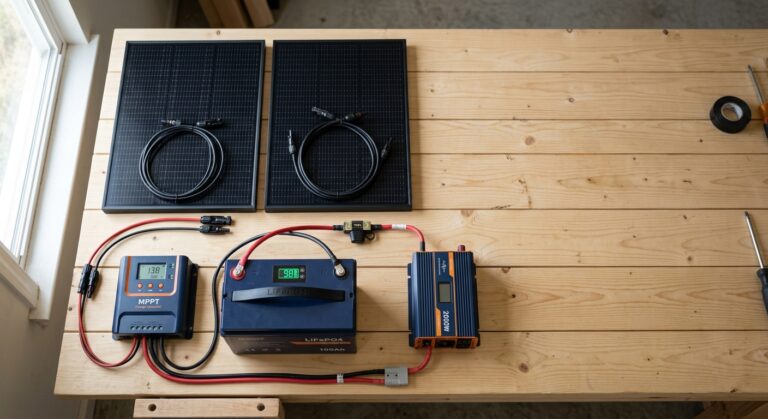
A budget van conversion ($30,000 to $60,000 total vehicle cost) typically features an isolated 100Ah battery, a basic PWM solar controller, and a small inverter.
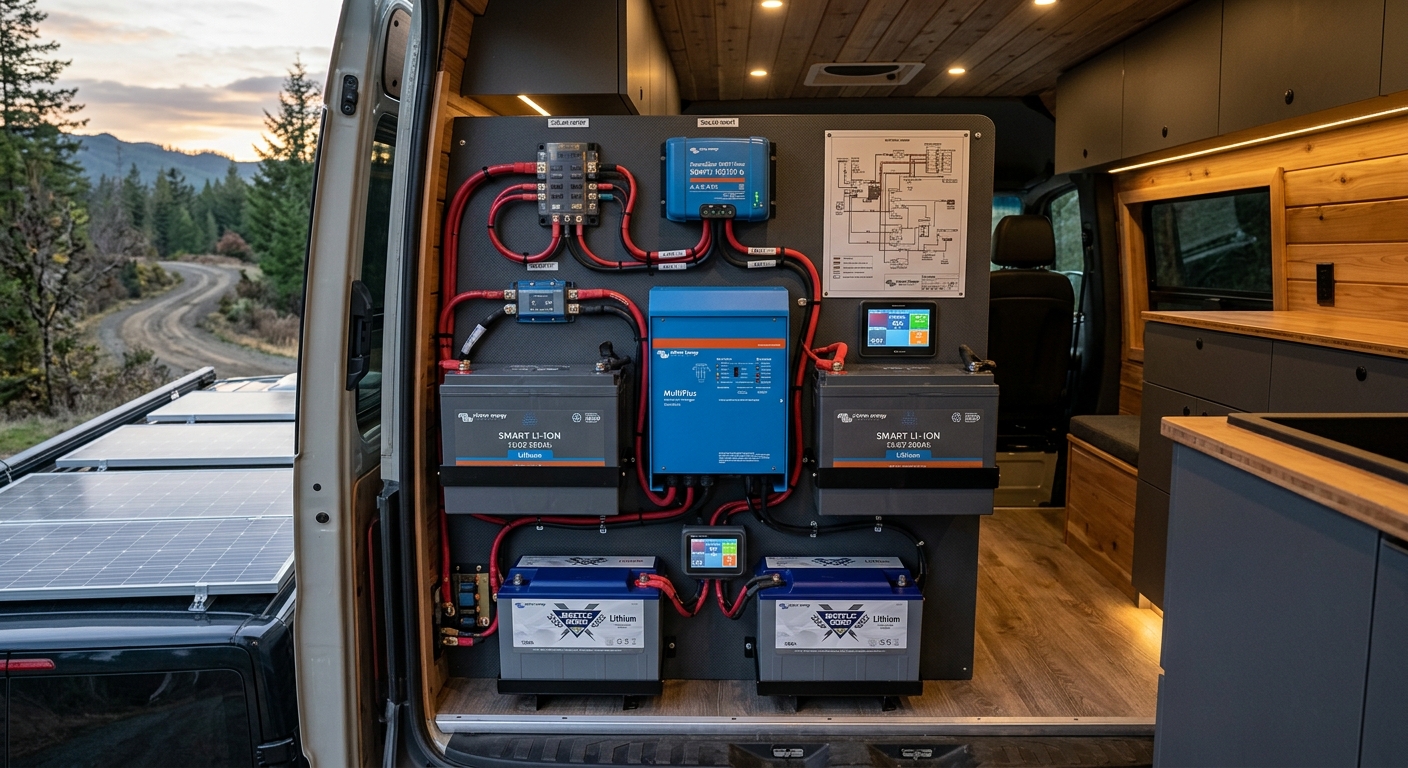
In contrast, a high-end 150k camper van build acts as a robust microgrid on wheels, featuring:
- Lithium (LiFePO4) battery bank: 400Ah to 800Ah at 12V, or an efficient 24V/48V electrical architecture.
- Rooftop camper van solar array: 400W to 800W of monocrystalline solar panels (rigid or semi-flexible).
- Inverter/charger combination: A 3000W pure sine wave inverter (such as a Victron MultiPlus-II) capable of running induction cooktops and AC units.
- DC-DC secondary alternator charging: Rapidly recharges the lithium batteries while driving.
Budget vs professional: component comparison
| Component | Budget / DIY Build | $150K Professional Build |
|---|---|---|
| Batteries | Generic lead-acid or budget LiFePO4 ($300–$600) | Premium Lithium (Battle Born, Victron, Mastervolt) ($3,000–$7,000) |
| Inverter | Modified sine wave ($150–$300) | Pure sine wave Victron MultiPlus-II ($1,500–$2,500) |
| Monitoring | Basic battery voltage gauge | Touchscreen (Cerbo GX / Touch 50) + mobile app remote monitoring |
| Wiring & Safety | Standard copper wiring, basic inline fuses | Marine-grade tinned copper, Blue Sea fuses, circuit breakers, thermal management |
Why the electrical system costs $15,000 to $25,000
The total camper van electrical system cost in luxury builds reflects precise engineering, premium hardware, and safety standards:
- Custom wiring & voltage drop management: Sizing correct wire gauges, minimizing circuit distance, and integrating thermal cut-offs requires professional solar engineering.
- Safety standards compliance: Top builders follow strict ABYC or RVIA guidelines, fusing every positive connection. Road vibration can wear down wire insulation, risking electrical shorts and fires without proper protection.
- Tri-mode charging architecture: Seamlessly combines rooftop solar when stationary, secondary alternator power while driving, and shore power at campgrounds.
Is a custom camper van worth it? The verdict
It is worth it if: You live in your van full-time across climate extremes, run heavy appliances like a roof AC on battery power, work remotely as a digital nomad, or spend extended periods in remote backcountry locations.
It is not worth it if: You stick to weekend camping with RV hookups or prefer a simplified setup with a portable power generator and propane stove. If that matches your style, start by reading our solar panel kit with battery and inverter guide or our in-depth solar generator for RV guide.
Frequently Asked Questions
How much does a camper van power system cost?
A basic DIY system costs between $1,000 and $3,000. A professional, off-grid lithium build with a 3000W inverter, alternator charging, and smart monitoring typically costs $15,000 to $25,000 installed.
How many solar panels does a camper van need?
Most camper vans operate efficiently on 400W to 800W of rooftop solar. Size your solar array according to daily watt-hour consumption rather than available roof space alone.
Is LiFePO4 better than AGM for a camper van?
Yes. LiFePO4 (Lithium Iron Phosphate) offers significant advantages over AGM: it is lighter, supports thousands of charge cycles, and allows 100% depth of discharge. Ensure your setup includes cold-weather charging protection.
Can a camper van run air conditioning on solar?
Yes, provided you install a large lithium battery bank (600Ah+) and a high-efficiency 3000W inverter. Solar replenishment takes time, so alternator charging is often essential to maintain continuous AC operation.
Final Thoughts
A $150,000 camper van is more than luxury wood finishes—you are investing in a reliable off-grid van electrical system that won't fail in extreme desert heat or on rugged mountain tracks. Properly engineered, it turns your van into a completely self-sustaining mobile residence.