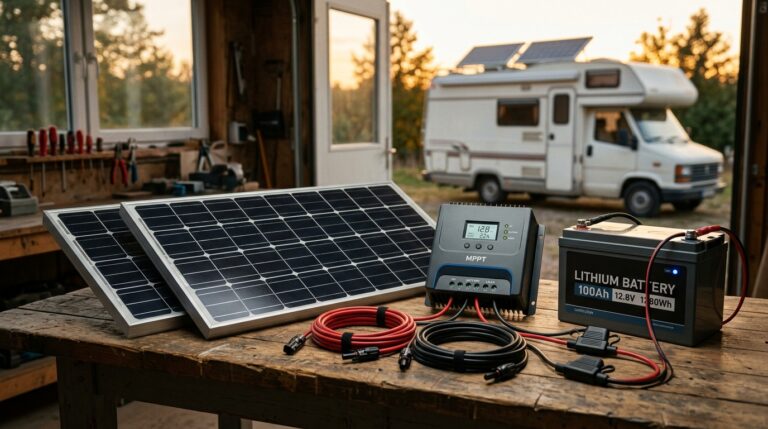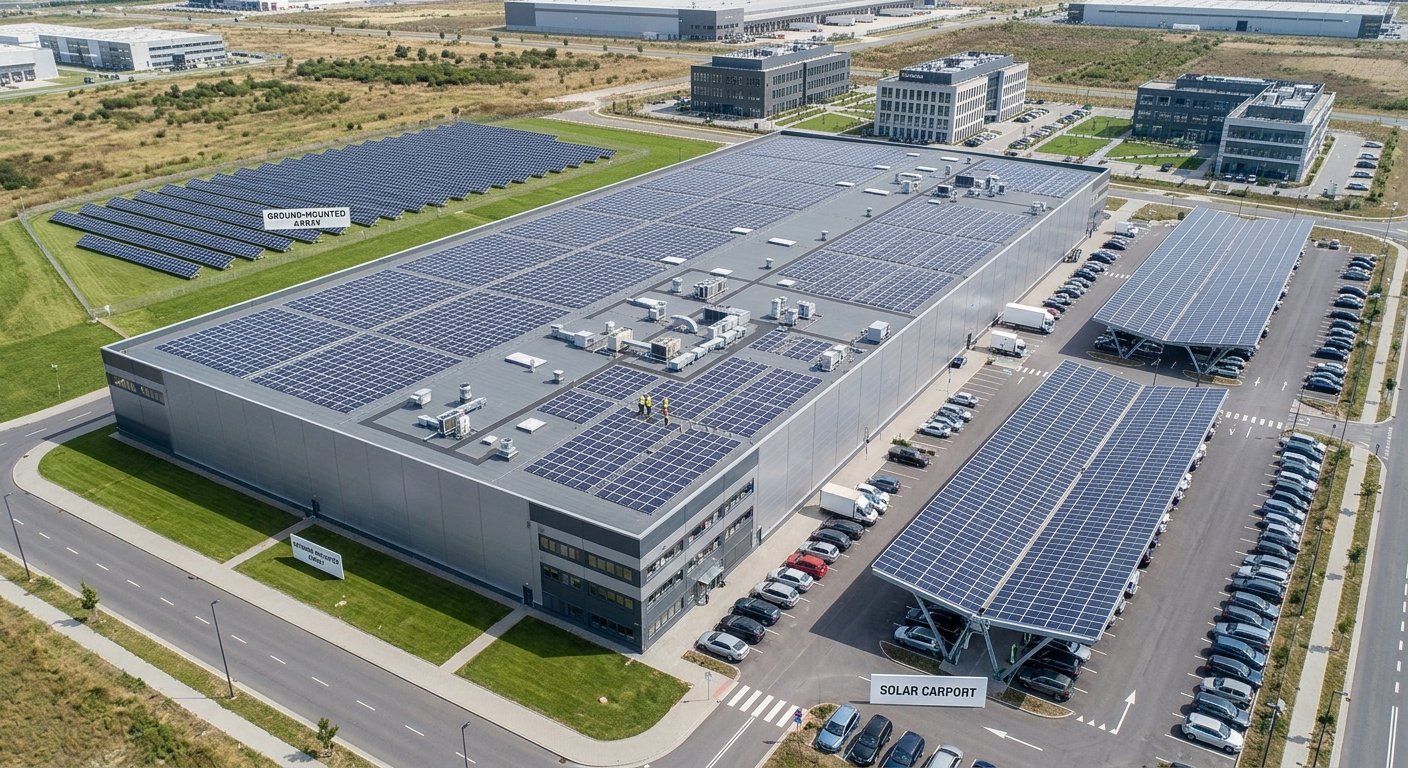
Commercial solar and EV charging now pay back best when you plan them as one project, and 2026 changed the rules on timing. The federal EV charger credit (Section 30C) ended for equipment placed in service after June 30, 2026, and the commercial solar credit (Section 48E) now depends on when construction began or when the system enters service.
This guide is for property owners, facility managers and developers who want to add solar panels and charging stations to a business site. It follows the order of your decisions: needs, sizing, system type, hardware, cost, software, installation, maintenance and ROI. If you are new to the topic, start with our primer What is Commercial Solar?.

1. Understand Your Property’s Commercial Solar and EV Charging Needs
Start with three numbers: how much power your building uses, how much roof or land you can cover, and how many vehicles will charge. Every later choice follows from them.
Assess current and future energy use
Pull 12 months of utility bills and ask your utility for 15-minute interval data, because it shows when you use power and not only how much. Note four things: annual kWh, monthly peak kW, your rate schedule with time-of-use periods, and your demand charges, which bill you for your highest 15-minute peak. Then add what is coming, such as a building extension, HVAC electrification or company EVs. Solar earns the most when you use the energy on site during daylight.
Evaluate solar potential and space
Walk the site with an installer and check usable roof area after fire-code setbacks, roof age and structure, orientation and shade, and any ground or parking area that could host a ground mount or carport. A roof near the end of its life should be replaced before panels go on.
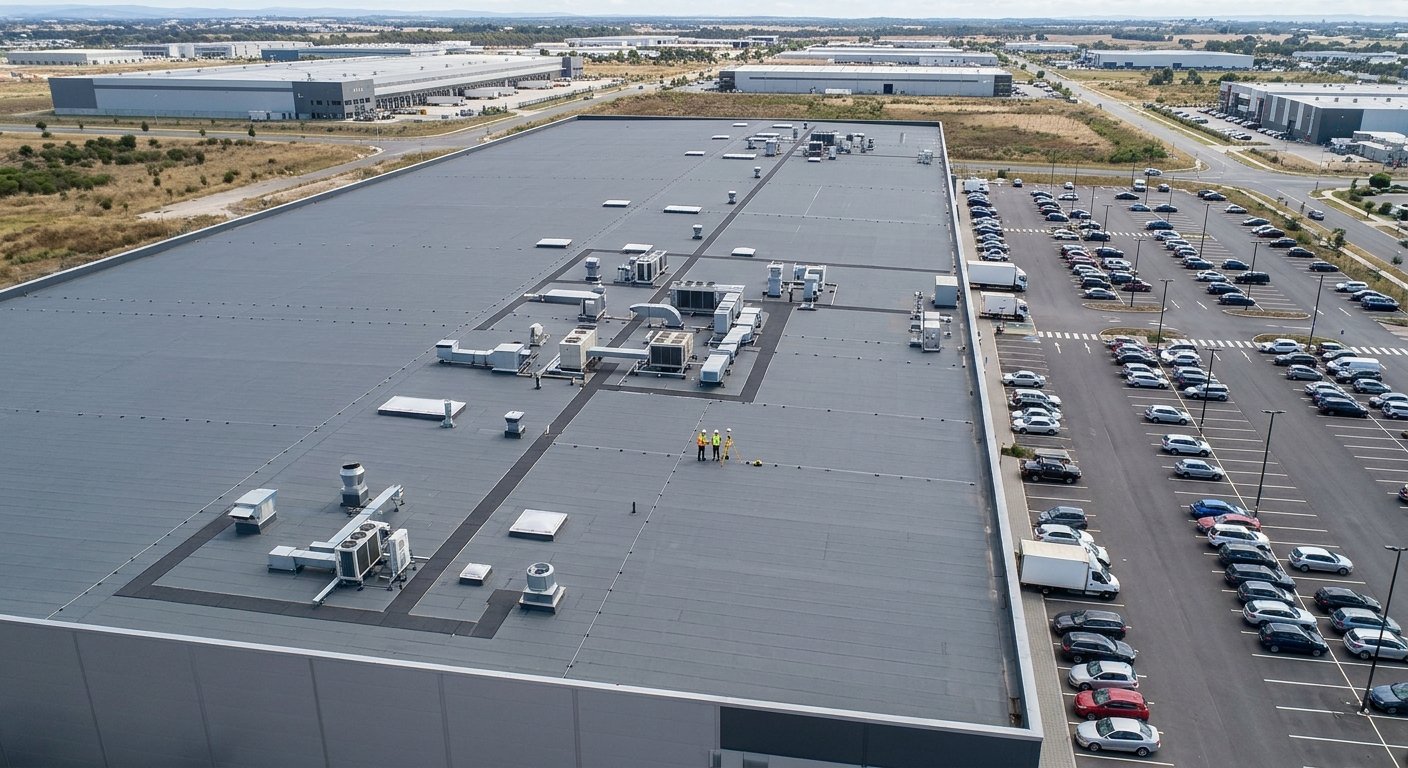
As a first estimate, plan on roughly 100 square feet of array per kW. A 250 kW system needs about 25,000 square feet, according to GreenLancer. The free NREL PVWatts calculator gives a first production estimate for your address.
Estimate EV charging demand
Dwell time decides the charger type. Employees and residents who park for hours need Level 2. Drivers who stop for under an hour need DC fast charging. Level 2 adds roughly 20 to 40 miles of range per hour, per Qmerit. Expect low use at first and growth later: install the ports you need today, but size conduit and panel space for the ports you will add.
2. Size Your Commercial Solar and EV Charging Capacity
Size solar to your daytime load plus charging, not to the size of your roof.
- Set your annual kWh target and the share you want solar to cover.
- Divide by your site’s annual yield (kWh per installed kW) to get the system size.
- Add daily charging energy: ports × hours in use × charger kW × expected utilization.
- Check that your electrical service can carry the combined load.
Example: to offset 300,000 kWh a year at an assumed 1,500 kWh per kW, you need about 200 kW of solar. Replace that yield with your own estimate, because it varies widely by location.
For charging, divide the energy a driver needs by the hours parked. A driver who needs 40 kWh during an 8-hour shift needs only about 5 kW, so a 7 to 12 kW Level 2 port is enough. Estimate how many EVs charge at your busiest hour, use shared-power chargers when ports will not all run at full power together, and budget $3,000 to $7,000 per accessible charging space for ADA compliance (Qmerit). Pull extra conduit now so you never dig twice.
3. Choose the Right Solar System for Your Chargers
Most commercial sites are best served by a grid-connected system. Add batteries only where outages, demand charges or time-of-use rates justify the cost. Grid-tied inverters shut down when the grid goes down, so backup power requires a hybrid design.
| System | How it works | Best for | Main trade-off |
|---|---|---|---|
| On-grid | Solar powers the building and exports extra to the grid | Most businesses with daytime loads | Shuts down during a grid outage |
| Hybrid | On-grid system plus a battery | Demand charges, time-of-use rates, critical loads | Higher cost and maintenance |
| Off-grid | No utility connection | Remote sites | Largest battery, often a generator |
Rooftop, ground mount or carport
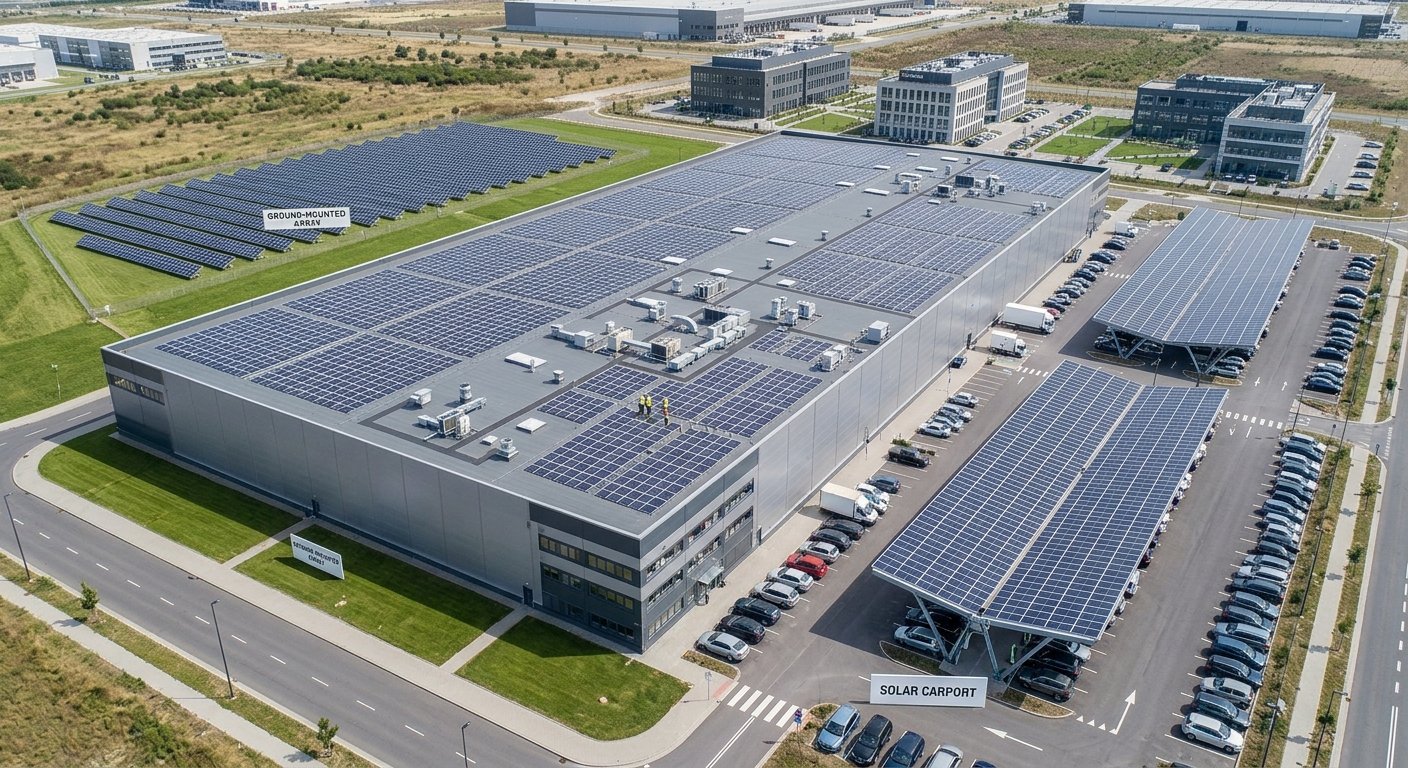
| Mounting | Advantages | Drawbacks |
|---|---|---|
| Rooftop | Uses space you already own; no land needed | Limited by roof area, age and structure |
| Ground mount | Easier to orient and maintain; no roof risk | Needs land; adds pile driving and trenching |
| Carport | Shades vehicles; natural home for chargers | Higher structural and engineering cost |
Typical modules reach 20% to 23% efficiency. Standard monocrystalline (PERC or TOPCon) is the best value; premium modules only pay off when space is tight, and bifacial modules suit ground mounts and carports. Since 2026, panels or inverters with parts from prohibited foreign entities can make a project ineligible for the federal credit, according to Solar Power World, so check where equipment comes from.
4. Level 2 vs. DC Fast Charging for Commercial Sites
A grid-connected station is the better choice for almost every business. It is reliable, it can bill drivers, and your solar system still cuts the energy cost. Choose the charger by how long drivers stay.
| Level 2 | DC fast charging | |
|---|---|---|
| Power output | 3.3 to 19.2 kW | 50 to 500 kW |
| Typical use | Workplaces, hotels, multifamily, retail | Highway sites, fleets, high-traffic public sites |
| Installed cost per port | $3,500 to $15,000 | $18,000 to $350,000+ |
| Electrical service | 240 V circuits | Typically 480 V three-phase |
Where cars stay two hours or more, Level 2 is the better value. Three layouts are common: rooftop solar on the building (simplest and cheapest), a solar carport over the charging bays (adds shade and visibility), or solar plus a battery with a controller (best for high demand charges). Ask your electrician about National Electrical Code articles 625 (EV charging), 690 (solar), 705 (interconnected sources) and 706 (energy storage).
5. Hardware Checklist for Commercial Solar and EV Charging Systems
Buy on lifetime cost, safety listings and support, not on the lowest quote.
- Panels: 25 to 30 year power warranty, low annual degradation, a good temperature coefficient, and IEC 61215 / IEC 61730 certification.
- Inverters: string inverters suit most commercial roofs; microinverters or optimizers suit shaded roofs; central inverters suit large ground mounts. Expect a 10 to 15 year life and a $5,000 to $30,000 replacement (GreenLancer). Look for UL 1741 listing and rapid shutdown compliance.
- Batteries: most commercial units use lithium iron phosphate (LFP). Look for UL 9540 listing and an NFPA 855 fire-code review. Batteries rarely pay off for energy savings alone; they pay through demand-charge reduction, backup or time-of-use savings.
- Connectors: J1772 is the long-standing Level 2 standard, and NACS (SAE J3400) is now adopted by most major automakers. Choose chargers that can serve both.
- Networked chargers: they enable payments, remote monitoring and reports, at about $275 to $480 per port per year in software fees (Qmerit). Many utility programs require them.
- OCPP: the open standard from the Open Charge Alliance lets you change software providers without replacing chargers. Version 2.0.1 has stronger security and smart-charging controls than 1.6.
- Durability: UL 2594 or UL 2202 listing, a NEMA 3R or NEMA 4 enclosure for outdoor use, and a clear warranty with service terms.
6. Total Cost of Ownership
The purchase price is only part of the cost. Electrical work often costs more than the chargers themselves.
- Solar: the average US commercial system cost $1.77 per watt DC in Q2 2026, up 5.6% year over year (SEIA and Wood Mackenzie, via GreenLancer). Most businesses spend $150,000 to $600,000. Modules fell to about $0.37 per watt, but tariffs raised wiring and racking costs.
- Chargers: $3,500 to $15,000 per Level 2 port and $18,000 to over $350,000 per DC fast port, all-in.
- Add-ons: trenching at $75 to $150 per linear foot, permitting and project management at 3% to 5% each, and site safety at $1,000 to $3,000 per project.
- Upkeep: solar inspection $200 to $600 a year, cleaning $10 to $30 per panel when needed, and charger network fees. Battery replacement runs $10,000 to $100,000 after 10 to 15 years, so include it in a 20-year model.
Savings come from fewer kWh bought, lower demand charges and payment for exported power. You can bill drivers per kWh (fairest for public charging), per hour or session (suits Level 2), add idle fees, or offer charging free as a tenant or employee benefit. Price above your electricity cost and in line with nearby public chargers.
7. Incentives for Commercial Solar and EV Charging in November 2026
| Incentive | Status | What to know |
|---|---|---|
| Solar credit (Section 48E) | Active, with deadlines | 30% when prevailing wage and apprenticeship rules are met, or for systems under 1 MWAC. Projects that began construction by July 4, 2026 have four years to finish. Others must be placed in service by December 31, 2027. |
| EV charger credit (Section 30C) | Ended | No credit for property placed in service after June 30, 2026 (see the IRS Form 8911 page). |
| Bonus depreciation | Active | 100% first-year deduction for qualified property acquired after January 19, 2025. |
| Direct pay and transfer | Active | Tax-exempt owners can receive the credit as cash; others can sell it. |
| State and utility programs | Varies | Rebates and make-ready programs may cover chargers or wiring. |
Search your state in the DSIRE incentives database, ask your utility about make-ready programs, and confirm your tax position with a CPA.
8. Software and Energy Management
Software decides whether the system runs well after installation day. Choose open, secure platforms that you can hand to a new provider.
- Solar monitoring: inverter-level data, alerts, and actual-versus-expected output. A drop is the first sign of shade, soiling or a failing string.
- Access control: open access, RFID or app-based access, and separate prices per driver group.
- Billing: per-kWh billing, receipts and exportable reports.
- Load management: it caps total charging power, pauses charging at peak hours and raises it when solar output is high. For many sites it is the cheapest way to add ports without a service upgrade.
- Reporting: energy delivered, sessions, uptime, revenue and avoided utility cost, exportable as CSV.
9. Installation Planning and Timeline
The longest delays come from the utility, permits and equipment lead times, not construction. Start all three early, in parallel, and treat your tax-credit deadline as a fixed date. Have an electrician review service size, panel space, transformer capacity and breaker slots; many properties need panel upgrades or a new transformer. Place chargers close to the panel to cut trenching cost, and align charging bays under a carport array so one structure serves both.
| Phase | Typical duration |
|---|---|
| Site assessment and design | 4 to 8 weeks |
| Permitting and utility application | 2 to 12 weeks |
| Equipment ordering | 8 to 20 weeks, longer for transformers and switchgear |
| Utility upgrades, if needed | Several months to a year or more |
| Construction | A few weeks for Level 2, longer for solar and DC fast charging |
| Inspection and permission to operate | 2 to 8 weeks |
Because new projects must be placed in service by December 31, 2027 to claim the 48E credit, delays in permission to operate are a real tax-credit risk. Submit the interconnection application at the same time as the permit drawings.
10. Maintenance, Uptime and Warranties
Solar needs little attention. Chargers need much more, because a broken charger loses revenue and driver trust right away.
- Solar: one annual inspection, monthly review of monitoring data, and cleaning only when dust, pollen or snow cut output. Use low-pressure water and never walk on panels.
- Inverters and batteries: keep vents clear, apply firmware updates and follow the manufacturer’s schedule.
- Chargers: regular inspections, software updates, cable and connector checks, and code audits. Replace worn cables quickly.
- Uptime: track the percentage of time each port is available. A common target is 97% or higher. Set alerts and name one person responsible for responding.
- Warranties: modules 25 to 30 years on output, inverters 10 to 15 years, installer workmanship 5 to 10 years. For chargers, ask who pays for labor and travel on a repair.
11. Build Your Commercial Solar and EV Charging ROI Model
A simple payback model takes an hour and tells you whether a project deserves a detailed study. This example uses 200 kW of solar and six Level 2 ports. The yield, electricity price, upkeep and usage are illustrative assumptions, so replace them with your own.
| Line | Amount |
|---|---|
| Solar system (200 kW at $1.77 per watt) | $354,000 |
| Six Level 2 ports at $8,000 | $48,000 |
| Total project cost | $402,000 |
| Section 48E credit at 30% of solar cost, if eligible | −$106,200 |
| Net cost with credit | $295,800 |
| Annual benefit (solar $39,000 + charging about $11,500) | about $50,500 |
| Simple payback with credit | about 5.9 years |
| Simple payback without credit | about 8.0 years |
How the benefit is built: 200 kW × 1,500 kWh = 300,000 kWh, worth $42,000 at $0.14, or $39,000 after $3,000 upkeep. Charging delivers 65,700 kWh a year (6 ports × 2 sessions × 15 kWh × 365 days); at a $0.21 margin that is about $13,800, or about $11,500 after $2,280 in network fees.
The EV charger credit is zero in this model. The model also leaves out bonus depreciation, financing costs, state incentives and rising utility rates. Before you commit, extend it to 20 to 25 years with panel degradation, an inverter replacement and rising fees, and have your CPA run NPV and IRR on the final numbers. You can size the load first with our sizing calculators.
Commercial Solar and EV Charging FAQ
Can solar panels power commercial EV charging stations?
Yes. On a grid-connected site, solar supplies the building and chargers first and the grid covers the rest. Charging only from panels needs a battery, and charging stops when the battery is empty.
How many solar panels are needed to charge one EV?
An EV driven 12,000 miles a year at about 3.5 miles per kWh uses roughly 3,400 kWh. At 1,500 kWh per kW, that needs about 2.3 kW of solar, or roughly 4 to 6 modern panels.
Which commercial solar system is best for most businesses?
A grid-tied rooftop system has the lowest cost and simplest design. Choose a hybrid system with a battery if you have high demand charges, time-of-use rates or loads that must stay on during outages.
Can EV chargers run without battery storage?
Yes. Most commercial chargers run directly from the grid with solar offsetting the energy. A battery helps where demand charges are high or chargers must keep running in an outage. See our solar battery comparison for options.
How many charging stations does a commercial property need?
There is no single rule. Estimate how many EVs charge at your busiest hour, check local codes that often require EV-ready spaces, and run conduit and panel capacity for future ports.
Can businesses sell excess solar electricity to the grid?
Usually yes, through net metering, net billing or buy-all-sell-all programs, but export rates vary widely and have fallen in some states. Size the system for on-site use.
How long does it take to recover the investment?
In this guide’s example, about 6 years with the 48E credit and 8 years without it. Your result depends on your rates, on-site solar use, charging demand and incentives.
Next Steps for Your Commercial Solar and EV Charging Project
The best next step is a short, honest estimate before you request quotes. In one week you can collect 12 months of bills and your rate schedule, measure your usable roof or parking area, estimate how many EVs charge at your busiest hour, and ask installers for itemized quotes with the construction and placed-in-service dates they can guarantee. Browse more in our Commercial Solar and EV & Charging categories.
This guide is general information, not tax, legal or engineering advice. Confirm incentives with a CPA and have licensed professionals design and install the system. Figures checked November 1, 2026.
Sources
- IRS, Form 8911 instructions: Section 30C termination date
- Solar Power World: Section 48E deadlines, foreign-entity rules, direct pay
- GreenLancer: commercial solar cost per watt (citing SEIA and Wood Mackenzie), maintenance, warranties
- Qmerit: EV charger installed costs, add-on costs and network fees